
Introduction
A Mutual Fund Portfolio Review is not something investors need to do every time the market moves. A portfolio can remain suitable through many periods of market volatility, while changes in your goals, time horizon, financial circumstances or risk capacity may make a review necessary.
Investing in mutual funds is not a “buy it and forget it” exercise.
But it is also not a “check your portfolio every day” exercise.
This is where many investors become confused.
Some investors rarely look at their mutual fund portfolio even when their financial circumstances have changed significantly. Others check their NAVs, returns and rankings constantly and feel compelled to make changes whenever markets move.
Neither extreme is particularly helpful.
A mutual fund portfolio should be reviewed periodically and purposefully — not emotionally.
The real question is not:
“Are my mutual funds giving the highest return?”
A more useful question is:
“Does my mutual fund portfolio still make sense for my goals, time horizon, risk profile and current financial circumstances?”
A portfolio that was appropriate three years ago may not be equally appropriate today if your goals, income, liabilities, time horizon or risk capacity have changed.
So, when should you review your mutual fund portfolio?
Let’s look at the important situations.
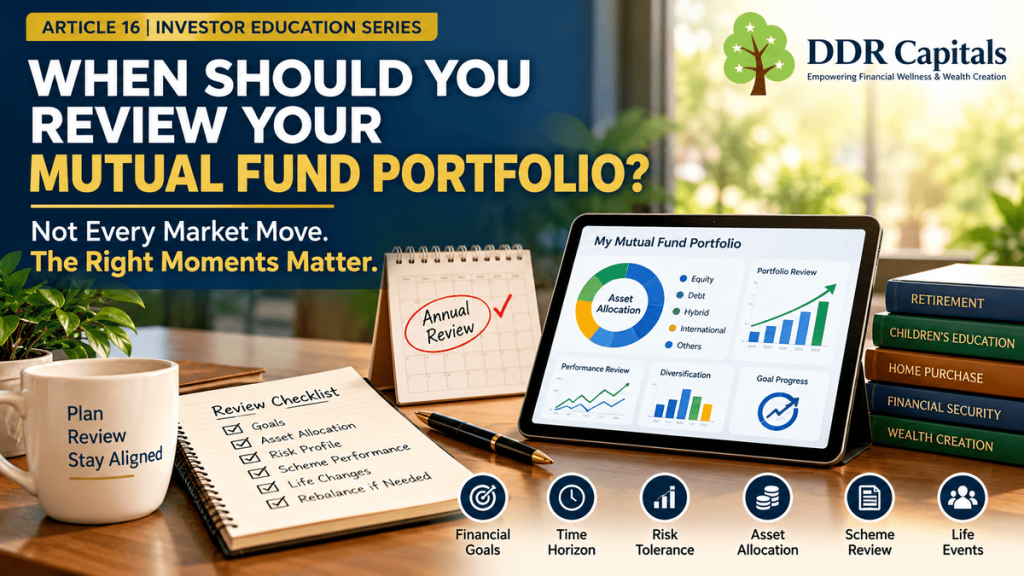
Review Your Portfolio at Least Once a Year
For many investors, an annual portfolio review can provide a useful structured checkpoint.
This does not mean selling or changing investments every year.
It means reviewing:
- Your financial goals
- Your investment time horizons
- Asset allocation
- Risk tolerance and risk capacity
- Portfolio diversification
- Scheme performance
- Portfolio changes
- Investment costs
- SIP contributions
- Progress toward your goals
- Any changes in your financial circumstances
AMFI provides fund fact sheets containing information such as investment objectives, fund manager details, AUM, benchmark, expense ratio, portfolio data, risk measures and performance. These disclosures can be useful starting points for reviewing a mutual fund scheme.
Review does not automatically mean replace.
Sometimes the correct decision after a review is simply:
“Everything is still aligned. Continue.”
That can be a perfectly valid outcome.
Review When Your Financial Goals Change
Your investment portfolio exists to support your financial goals.
So when your goals change, your portfolio may need to be reviewed.
For example:
You may have originally invested primarily for long-term wealth creation.
Later, you may decide that you need money for:
- A child’s education
- A home purchase
- Retirement
- A business requirement
- A major family expense
- A planned international education
- Financial security
- A future inheritance or legacy objective
Each goal can have a different time horizon and liquidity requirement.
A portfolio designed for a 15-year goal may not be appropriate for money that you expect to need in two years.
This is why goal review should come before fund review.
Before asking:
“Which mutual fund should I change?”
ask:
“Has the purpose of this money changed?”
Review When Your Time Horizon Becomes Shorter
Time can change the suitability of an investment strategy.
Suppose you started investing for retirement 15 years before retirement.
At that time, you may have had a long investment horizon.
But as retirement approaches, the number of years available to recover from a major market decline becomes shorter.
That does not automatically mean that an investor should eliminate equity investments.
It means the portfolio deserves a fresh review of:
- Time horizon
- Risk capacity
- Liquidity requirements
- Asset allocation
- Expected cash-flow needs
- Goal priority
Different mutual fund categories carry different risk and return characteristics. AMFI notes, for example, that equity schemes generally seek long-term growth but can be volatile in the short term.
Therefore, the same portfolio structure may not remain appropriate throughout every stage of an investor’s life.
Review After a Major Change in Income
Your income is an important part of your financial life.
If your income changes significantly, your investment strategy may need to be reviewed.
Examples include:
Income increases
You may now be able to:
- Increase SIPs
- Add investments toward new goals
- Increase retirement contributions
- Build additional financial reserves
Income decreases
You may need to reconsider:
- SIP amounts
- Cash-flow requirements
- Emergency reserves
- Short-term liquidity
- The priority of different goals
Retirement or semi-retirement
Your focus may gradually shift from accumulation toward a combination of:
capital preservation + liquidity + income requirements + long-term growth.
The important point is that your portfolio should reflect your financial life, not simply your past investment decisions.
Review After a Major Life Event
Some of the most important reasons to review a portfolio have nothing to do with the stock market.
They have to do with life.
Consider reviewing your portfolio after major events such as:
- Marriage
- Birth of a child
- Children’s education plans changing
- Purchase of a home
- Taking a large loan
- Selling a business
- Starting a business
- Retirement
- Significant inheritance
- Major change in family responsibilities
- Change in income
- Change in financial commitments
Your investment objectives may change even when your mutual funds themselves have not changed.
This is why portfolio review should not be driven only by market performance.
Review When Your Risk Capacity Changes
One of the most important distinctions in investing is between risk tolerance and risk capacity.
Risk tolerance
How comfortable are you with investment fluctuations?
Risk capacity
How much financial loss or volatility can your financial situation realistically absorb without jeopardising your goals?
These are not always the same.
An investor may psychologically be comfortable with high volatility but may not have the financial capacity to take substantial risk because the money is needed soon.
Conversely, an investor with a long time horizon and strong financial reserves may have greater capacity to tolerate market fluctuations.
Therefore, a portfolio review should consider both.
The Riskometer is one of the disclosures investors can use to understand the assessed risk level of a mutual fund scheme. SEBI requires scheme Riskometers to be evaluated monthly, with the Riskometer and portfolio information disclosed by AMCs and AMFI.
However, a Riskometer alone does not determine whether a scheme is suitable for a particular investor or goal.
Review When Your Asset Allocation Has Drifted
This is one of the most practical reasons for portfolio review.
Imagine you originally structured your portfolio with a particular balance between equity, debt and other investments.
Over time, market movements can change the relative value of those holdings.
Your portfolio may therefore no longer resemble the allocation you originally intended.
For example, an investor might have started with a particular allocation between growth-oriented and relatively more stable investments.
After a strong equity-market period, the equity portion could become a much larger percentage of the overall portfolio.
The question then becomes:
Has the portfolio’s risk level changed because the allocation changed?
This is where periodic review can help identify asset-allocation drift.
The objective is not necessarily to sell the best-performing fund.
The objective is to determine whether the overall portfolio still fits the intended structure and financial goals.
Review When a Mutual Fund Scheme Changes Materially
A mutual fund scheme can evolve over time.
During a review, investors can examine relevant scheme information such as:
- Investment objective
- Asset allocation
- Portfolio composition
- Benchmark
- Fund manager
- Riskometer
- Investment strategy
- Expense ratio
- Performance relative to benchmark
- Portfolio concentration
- Changes in the scheme’s characteristics
AMFI advises investors to evaluate mutual fund schemes using quantitative and qualitative factors including performance, portfolio, fund manager and asset manager rather than relying only on a single indicator such as a rating.
This is an important principle:
Do not review a fund only because its recent return looks attractive or disappointing.
Review the reason the fund was selected in the first place.
Review When a Fund Consistently Deviates From Its Purpose
Every mutual fund scheme has an investment objective and strategy.
The important question is whether the scheme continues to perform the role for which you selected it.
For example:
If a fund was selected as part of a particular long-term allocation, you should understand whether its current portfolio and strategy continue to fit that role.
This requires looking beyond a one-year return number.
AMFI’s investor education material points out that investors should track scheme performance with respect to its benchmark periodically when evaluating whether to remain invested or exit.
This does not mean that every period of underperformance is a reason to exit.
Markets move through different cycles, and investment strategies can go through periods of relative underperformance.
The review should therefore ask:
Is the underperformance temporary and explainable, or does it indicate a more fundamental change?
Review When You Find Yourself Constantly Comparing Funds
This may sound surprising, but sometimes the investor’s behaviour itself becomes a reason to review the portfolio.
You may find yourself asking:
- Why is another fund doing better?
- Why is my fund not number one?
- Should I switch?
- Should I invest in last year’s top performer?
- Why is my NAV lower?
- Should I stop my SIP?
This can turn investing into a continuous search for the next winner.
But a mutual fund portfolio should not be managed like a daily competition.
A high recent return does not automatically make another scheme appropriate for your goal.
AMFI specifically cautions against reacting to every market movement and notes that actively managed equity funds need reasonable time for their performance to be assessed.
Sometimes the best portfolio decision is not to make a transaction.
Don’t Confuse Portfolio Review With Daily Monitoring
This distinction is extremely important.
Daily monitoring asks:
“What happened today?”
Portfolio review asks:
“Is my investment strategy still appropriate?”
These are completely different questions.
Checking your NAV every day may tell you whether the value went up or down.
It does not necessarily tell you whether:
- Your goal is on track
- Your asset allocation is appropriate
- Your risk capacity has changed
- Your SIP amount is sufficient
- Your portfolio has become unnecessarily concentrated
- Your investment horizon has changed
More information does not automatically mean better investment decisions.
A Simple Annual Mutual Fund Portfolio Review Checklist
You do not need hundreds of data points to begin a useful review.
Start with these questions:
🎯 Goals
1. What are my current financial goals?
⏳ Time Horizon
2. When will I need the money for each goal?
⚖️ Risk
3. Has my risk tolerance or risk capacity changed?
🧩 Asset Allocation
4. Is my current asset allocation still appropriate?
📊 Scheme Role
5. Does each mutual fund still have a clear purpose in my portfolio?
📈 Performance
6. How has each scheme performed relative to its relevant benchmark and category over an appropriate period?
🔍 Portfolio
7. Has the underlying portfolio or investment strategy changed materially?
💰 Contributions
8. Are my SIPs and other investments still aligned with my goals?
🔄 Rebalancing
9. Has the portfolio drifted significantly from the intended allocation?
🌱 Life Changes
10. Has anything changed in my income, liabilities, family responsibilities or future requirements?
If the answers are broadly satisfactory, there may be no need for major changes.
When Should You NOT Review Your Portfolio?
This is equally important.
You generally should not feel compelled to make investment decisions simply because:
❌ The market fell sharply yesterday
❌ The market rose sharply this week
❌ Another mutual fund delivered a higher recent return
❌ Your NAV is temporarily down
❌ A friend told you about a “better” fund
❌ A social-media post predicts a market rally
❌ Your fund is temporarily underperforming
❌ A new fund has recently become popular
Mutual fund investments involve market risks, and past performance does not guarantee future performance.
A temporary decline is not automatically a portfolio problem.
A high return is not automatically proof that the portfolio is correctly structured.
Context matters.
The 5-Minute Mutual Fund Portfolio Review
Here is a simple exercise you can perform before making any investment decision.
Ask yourself:
1️⃣ What is this money for?
If you cannot answer this, the investment deserves a closer look.
2️⃣ When will I need it?
The time horizon can materially affect how you think about the investment.
3️⃣ Has my financial situation changed?
Income, liabilities, family responsibilities and liquidity needs matter.
4️⃣ Has the role of this mutual fund changed?
Know why you own it.
5️⃣ Am I reacting to information — or following a strategy?
This final question may be the most important.
If the only reason you want to change a fund is:
“Something else has gone up more recently,”
pause before acting.
Review the Portfolio — Not Just the Funds
A common mistake is to review each mutual fund separately without looking at the portfolio as a whole.
Suppose an investor owns ten different mutual funds.
It may appear highly diversified.
But if several funds hold similar companies, sectors or investment exposures, the actual portfolio may be less diversified than it appears.
This is why portfolio review should examine:
Fund → Portfolio → Asset Allocation → Goal
rather than looking at each fund in isolation.
A mutual fund itself provides diversification within its portfolio, but the investor’s overall collection of funds also needs to be considered. AMFI identifies diversification as one of the advantages of mutual funds, while different schemes can have very different underlying portfolios and strategies.
Your Portfolio Needs a Review When Your Life Changes — Not Every Time the Market Does
This may be the central message of this article.
Markets change constantly.
Your portfolio does not necessarily need to change constantly.
Your life, however, can change in ways that matter significantly to your investments.
A new goal.
A shorter time horizon.
A major financial commitment.
A change in income.
A change in risk capacity.
Retirement.
A family responsibility.
These events can justify a portfolio review.
A one-day market decline usually does not.
The Real Purpose of a Mutual Fund Portfolio Review
The purpose of reviewing your portfolio is not to find yesterday’s winner.
It is not to make the maximum number of transactions.
It is not to predict the next market movement.
And it is not to make your portfolio look more complicated.
The purpose is much simpler:
To check whether your investments are still aligned with your goals, time horizon, risk capacity and financial circumstances.
Sometimes the review may lead to a change.
Sometimes it may lead to rebalancing.
Sometimes it may lead to increasing or reducing contributions.
And sometimes the review may conclude:
“Stay with the strategy.”
That is also a decision.
Key Takeaways
- Review your mutual fund portfolio periodically — not emotionally.
- An annual structured review can provide a useful checkpoint.
- Review when your financial goals change.
- Review when your investment time horizon becomes shorter.
- Review after major changes in income, liabilities or family responsibilities.
- Review when your risk tolerance or risk capacity changes.
- Check whether your asset allocation has drifted.
- Review material changes in a scheme’s objective, strategy, portfolio or management.
- Do not switch funds simply because another fund recently performed better.
- Do not confuse daily NAV monitoring with meaningful portfolio review.
- Review the entire portfolio, not just individual mutual funds.
- The objective of a review is alignment — not unnecessary activity.
The Real Test of a Healthy Mutual Fund Portfolio
A healthy portfolio is not necessarily the one with the highest recent return.
It is the one where you can clearly explain:
What is each investment for?
When will I need the money?
What level of risk am I taking?
Does the portfolio still fit my financial circumstances?
Am I following a strategy rather than reacting to market noise?
If you can answer these questions clearly, you are already thinking beyond simply looking at returns.
And that is what a meaningful portfolio review should achieve.
Continue Your Investor Education Journey
If you found this article useful, you may also want to read:
Article 11: The 10-Minute Investment Health Check Every Investor Should Do
Article 12: Are You Investing for a Goal or Just for Returns?
Article 13: Your Investment Portfolio Has a Personality — Does It Match Yours?
Article 14: The Investment Mistakes That Look Smart at First
Article 15: One Portfolio, Many Goals: How to Organise Your Investments
Together, these articles explore an important principle:
Good investing is not about constantly doing something. It is about making thoughtful decisions for the right reasons.
About the Contributor
Mrs. Mansi Radadia
Operations & Compliance Officer, DDR Capitals
Contributor – Investor Education Series

Through the DDR Capitals Investor Education Series, Mansi contributes practical educational content designed to help investors understand investing concepts, portfolio discipline and long-term wealth-creation principles in a simple and meaningful way. Mrs. Mansi Radadia , Operations & Compliance Officer, DDR Capitals. Contributor – Investor Education Series. With a strong focus on investor servicing, operational excellence and regulatory compliance, she is committed to helping investors navigate their financial journey with confidence. She believes successful wealth creation is built on discipline, informed decision-making and staying invested through changing market cycles. She actively supports investor education initiatives and encourages investors to explore Investor Education Resources.
Disclaimer
This article is intended for general investor education and awareness purposes only. It should not be construed as investment advice, a recommendation, solicitation or an offer to buy or sell any mutual fund or other investment product. Mutual fund investments are subject to market risks. Investors should consider their own financial circumstances, investment objectives, risk profile and applicable product information before making investment decisions. Past performance does not guarantee future results.