
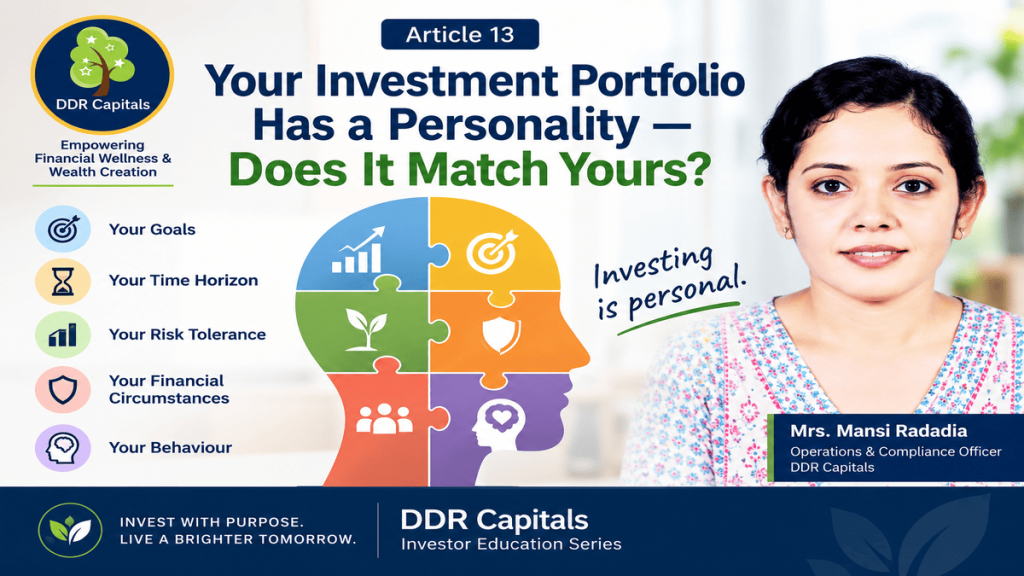
Your investment portfolio can look impressive on paper. But if you cannot stay comfortable with it during difficult markets, is it really the right portfolio for you?
Two investors can have the same income, the same age and even the same financial goal—and still need very different investment approaches.
Why?
Because investing is personal.
Your financial responsibilities are different.
Your time horizon is different.
Your ability to withstand losses is different.
And perhaps most importantly, your behaviour during market uncertainty is different.
That is why an investment portfolio should not only be evaluated by what it owns.
It should also be evaluated by whether it matches the investor who owns it.
Your Portfolio Should Reflect You
Think of your portfolio as having a personality.
Some portfolios are aggressive.
Some are balanced.
Some are conservative.
Some are designed primarily for long-term growth.
Others place greater emphasis on stability and liquidity.
There is no single portfolio that is right for every investor.
The real question is:
Does your portfolio match your financial personality?
To answer that, you need to understand more than your expected return.
You need to understand yourself.
Risk Tolerance Is Only One Part of the Story
Investors often hear the term risk profile and think it simply means whether they are comfortable seeing their portfolio fluctuate.
But there is an important distinction between:
Risk tolerance — how much uncertainty or fluctuation you are emotionally comfortable experiencing.
Risk capacity — how much financial loss your circumstances can reasonably withstand.
You may be emotionally comfortable with significant market fluctuations, but if you need the money soon, your financial capacity to take that risk may be limited.
An investment portfolio should reflect not only your tolerance for risk but also your financial capacity.
The reverse can also happen.
You may have a long investment horizon and strong financial capacity, but become extremely uncomfortable when markets decline.
Both dimensions matter.
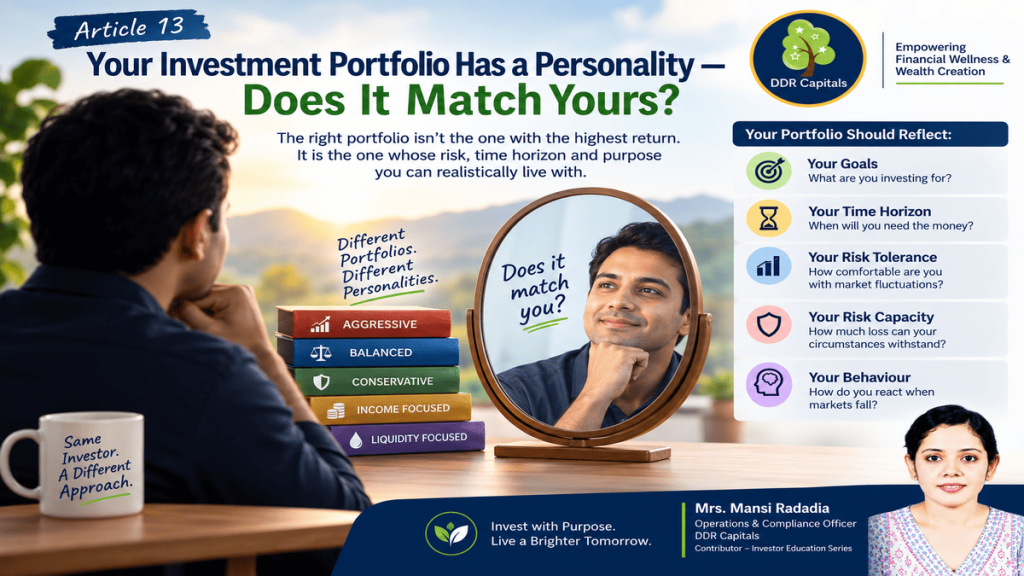
THE RIGHT PORTFOLIO ISN’T THE ONE WITH THE HIGHEST RETURN.
It is the one whose risk, time horizon and purpose you can realistically live with.
What Happens When Your Portfolio Doesn’t Match You?
Imagine an investor who chooses an aggressive portfolio because it performed exceptionally well recently.
During rising markets, everything feels comfortable.
Then the market declines.
The portfolio falls sharply.
The investor becomes anxious.
The original investment plan is abandoned.
Investments are sold.
The investor waits for the “right time” to return.
The problem may not have been the investment itself.
The problem may have been a mismatch between the portfolio and the investor’s ability to stay invested through volatility.
An investment strategy that looks excellent on paper can be unsuitable if the investor cannot remain committed to it.
Your Behaviour Is Part of Your Portfolio
Investors often analyse:
- Fund performance
- Asset allocation
- Past returns
- Market conditions
- Expense ratios
- Portfolio holdings
These can all be relevant.
But there is another factor that is sometimes overlooked:
Investor behaviour.
Ask yourself honestly:
What do I do when my portfolio falls 10%?
Would you:
🟢 Stay calm and follow your plan?
🟡 Become uncomfortable but continue?
🔴 Feel compelled to sell?
There is no shame in any answer.
The purpose is to understand yourself.
Knowing your likely behaviour before a difficult market arrives can help you build a more realistic investment approach.
When your circumstances change, your investment portfolio may also need to be reviewed.
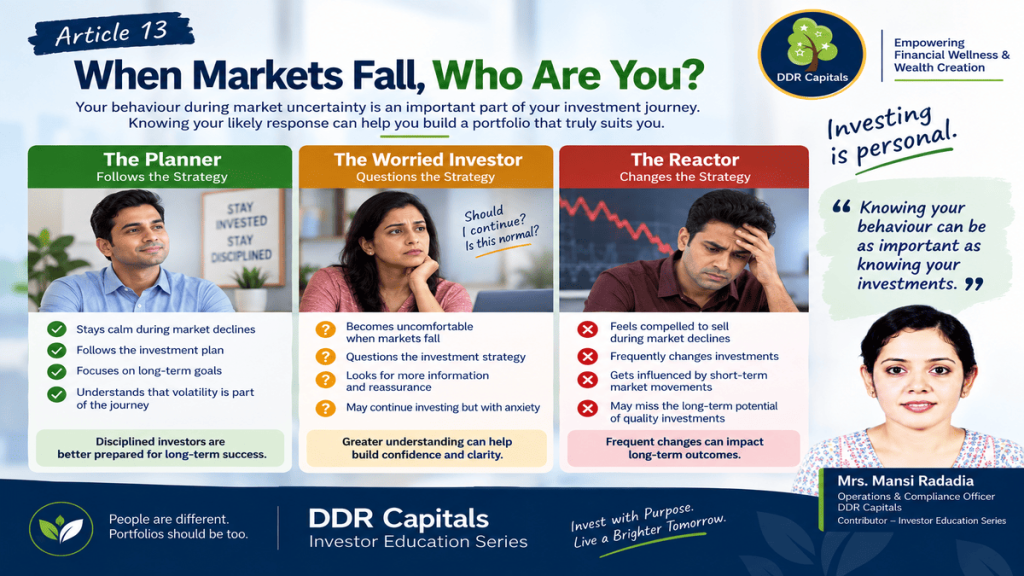
WHEN MARKETS FALL, WHO ARE YOU?
The Planner → Follows the strategy
The Worried Investor → Questions the strategy
The Reactor → Changes the strategy
Knowing your behaviour can be as important as knowing your investments.
Time Horizon Changes Your Portfolio Personality
Your portfolio should also reflect when you need the money.
Consider two investors.
Investor A is investing for retirement 20 years away.
Investor B needs the money for a major financial requirement in two years.
Even if both investors have the same emotional attitude toward risk, their investment circumstances are different.
The first investor may have more time to experience and potentially recover from market cycles.
The second investor has a much shorter period.
Therefore, time horizon matters when evaluating whether the level of risk is appropriate.
Risk should always be viewed in context.
Your Financial Life Changes — Your Portfolio May Need to Change Too
Your investment personality is not necessarily permanent.
Life changes.
You may:
- Change jobs
- Start a business
- Receive an inheritance
- Take on a home loan
- Have children
- Approach retirement
- Increase your income
- Take on new financial responsibilities
These changes can affect your financial goals, liquidity requirements, risk capacity and time horizon.
That doesn’t mean you should constantly change your investments.
It means your portfolio deserves a periodic review. When your circumstances change, your investment portfolio may also need to be reviewed.
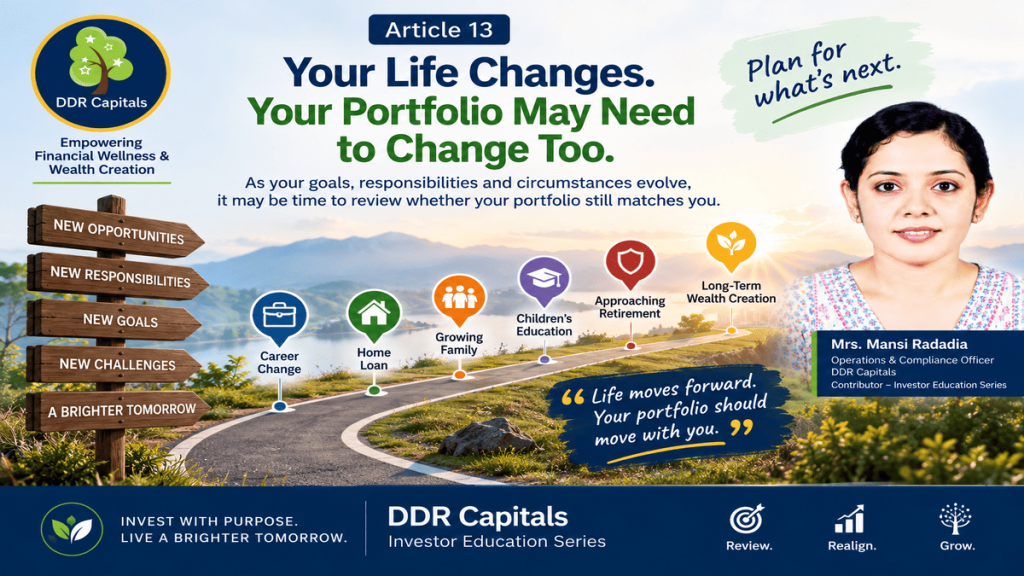
LIFE → GOALS → RISK CAPACITY → TIME HORIZON → PORTFOLIO
A change in your financial circumstances may be a reason to review your strategy.
Not every market movement is.
The Five Signs Your Portfolio May Not Match You
Here are five questions worth asking.
1. You cannot sleep when markets fall
If normal market fluctuations create extreme anxiety, your portfolio may carry more risk than you are psychologically comfortable with.
2. You constantly compare your returns
If you are always chasing whichever investment recently performed best, your portfolio may not have a clear purpose.
3. You frequently change investments
Constant switching can indicate that your strategy is being driven by short-term performance rather than a structured plan.
4. You don’t know why you own your investments
If you cannot explain the role of an investment in your portfolio, it may be time to review its purpose.
5. Your financial circumstances have changed
A portfolio that was appropriate several years ago may need to be reassessed after major changes in your financial life.
The 5-Minute Portfolio Personality Test
Take a few minutes and answer these questions honestly:
1. What is my most important financial goal?
2. When will I need this money?
3. How would I react if my portfolio temporarily declined significantly?
4. How much financial loss could my circumstances reasonably withstand?
5. Do I understand why each major investment is part of my portfolio?
If you cannot answer one or more questions, don’t panic.
It simply means that part of your investment strategy deserves further understanding.
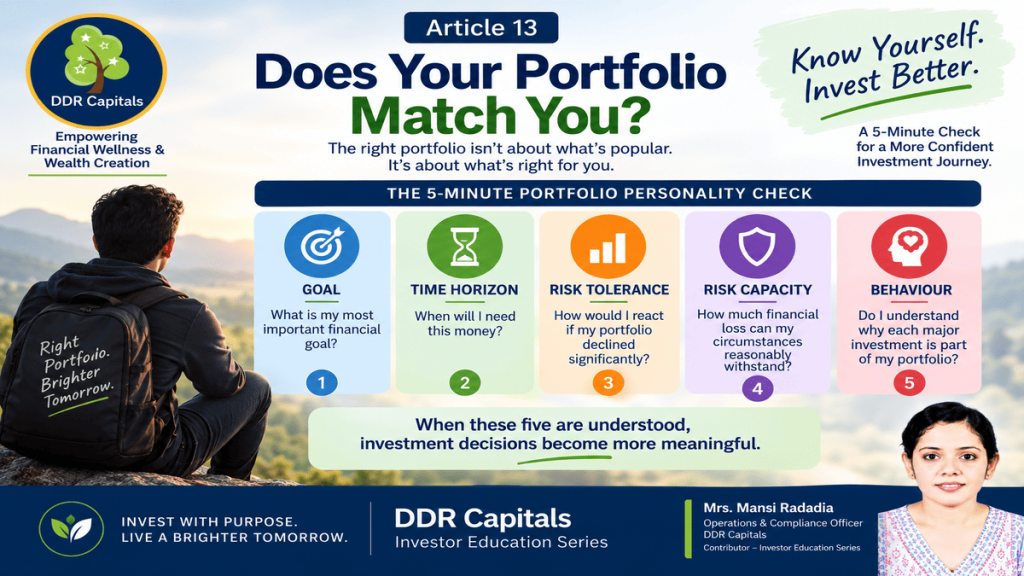
ASK YOURSELF FIVE QUESTIONS
🎯 Goal
⏳ Time Horizon
⚖️ Risk Tolerance
🛡️ Risk Capacity
🧠 Behaviour
When these five are understood, investment decisions become more meaningful.
Don’t Build a Portfolio You Cannot Live With
This may be one of the most important principles in long-term investing:
A theoretically excellent portfolio is of little use if the investor abandons it at the first difficult market cycle.
The objective is not to eliminate every uncomfortable moment.
Market fluctuations are a normal part of investing.
The objective is to create an investment approach that is appropriate enough for the investor to remain disciplined through those periods.
That requires honesty.
You need to know not only what you want your portfolio to do—but also how you are likely to behave when it doesn’t.
The Right Question Isn’t “What Should I Buy?”
A better sequence of questions is:
What am I investing for?
↓
When will I need the money?
↓
How much risk can my circumstances support?
↓
How much volatility can I realistically tolerate?
↓
How am I likely to behave during difficult markets?
↓
What investment approach fits all of these factors?
This changes investing from a product-selection exercise into a decision-making process.
Your Portfolio Should Work With You, Not Against You
Your portfolio does not need to look like someone else’s.
Your colleague may have a different allocation.
Your friend may have different investments.
A social-media influencer may talk about a completely different strategy.
That does not automatically make their approach appropriate for you.
Your investment strategy should be connected to your goals, your circumstances, your time horizon and your ability to handle risk.
The goal isn’t to build the most exciting portfolio.
The goal is to build an appropriate portfolio that you can stay committed to.
Key Takeaways
- Investing is personal; there is no single portfolio that suits everyone.
- Your portfolio should reflect your goals, circumstances and time horizon.
- Risk tolerance and risk capacity are different concepts.
- Your behaviour during market declines can influence investment outcomes.
- A portfolio that looks good on paper may not be suitable if you cannot stay invested through volatility.
- Major life changes can be a reason to review your investment strategy.
- More frequent changes do not necessarily mean better investing.
- Every major investment should have a clear purpose within the portfolio.
- Your portfolio should be designed around your financial life, not someone else’s.
- The right portfolio is one you can understand, manage appropriately and remain disciplined with over time.
Conclusion
Your investment portfolio has a personality.
The question is whether it has your personality.
If you are uncomfortable with its fluctuations, don’t understand why you own its investments, or find yourself constantly changing your strategy, it may be time to step back and understand the underlying mismatch.
That doesn’t automatically mean you need to sell anything.
It means you need to ask better questions.
What is my goal?
When will I need the money?
How much risk can I reasonably take?
How much volatility can I tolerate?
And how am I likely to behave when markets become difficult?
Once you understand these factors, your investment decisions can become more purposeful.
Because the best portfolio isn’t necessarily the one that looks the most impressive during a bull market. The right investment portfolio is one that you can understand, live with and remain committed to over time.
It is the one that you can stay committed to through the entire investment journey.
Continue Your Investor Education Journey
Article 9: Why Market Volatility Is Not the Real Risk
Article 10: The Hidden Value of Financial Advice
Article 11: The 10-Minute Investment Health Check Every Investor Should Do
Article 12: Are You Investing for a Goal or Just for Returns?
Article 13: Your Investment Portfolio Has a Personality — Does It Match Yours?
Disclaimer
This article is intended solely for investor education and awareness. It should not be construed as investment advice, a recommendation, or a solicitation to buy or sell any financial product or security. Investment decisions should be made after considering individual financial circumstances, investment objectives, time horizon, risk profile and risk capacity. Past performance does not guarantee future results. Investors should consult an appropriately qualified professional where necessary.
About the Author

Mrs. Mansi Radadia , Operations & Compliance Officer, DDR Capitals. Contributor – Investor Education Series. With a strong focus on investor servicing, operational excellence and regulatory compliance, she is committed to helping investors navigate their financial journey with confidence. She believes successful wealth creation is built on discipline, informed decision-making and staying invested through changing market cycles. She actively supports investor education initiatives and encourages investors to explore Investor Education Resources.