
Introduction
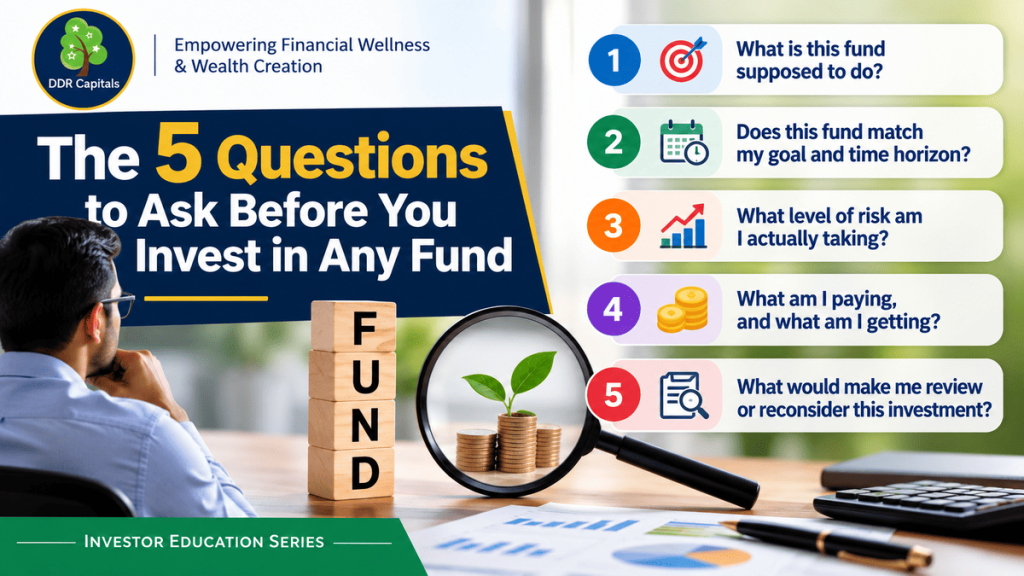
The questions to ask before investing in any fund are often more important than the fund’s recent returns.
Before you invest, you should understand what the fund is designed to do, whether it matches your financial goal and time horizon, what level of risk you are taking, what you are paying, and what circumstances could make you review the investment.
Many investors start with a simple question:
“How much return has this fund given?”
That is understandable—but it is not enough.
A fund that has delivered strong returns may still be unsuitable for a particular goal, time horizon or risk capacity. Similarly, a fund with modest recent performance may still have an important role in a long-term portfolio.
The purpose of this article is not to tell you which fund to buy.
Instead, it provides a simple framework of five questions to ask before investing in any fund so that your decision starts with understanding rather than excitement, fear or recent performance.
The questions to ask before investing in any fund are often more important than the fund’s recent returns. Before you invest, you should understand what the fund is designed to do, whether it matches your financial goal and time horizon, what level of risk you are taking, what you are paying, and what circumstances could make you review the investment. This article should be less about picking a “good” fund and more about deciding whether a fund is appropriate for a particular purpose.
Why Investors Often Choose Funds the Wrong Way
Choosing a fund can appear simple.
You may see:
- A fund with excellent recent returns
- A highly rated fund
- A fund frequently discussed online
- A fund recommended by friends or relatives
- A fund that has recently attracted large investments
- A fund that has performed particularly well during the last one or two years
The natural reaction is to think:
“This must be a good fund.”
But there is an important difference between:
“Is this a good fund?”
and
“Is this the right fund for what I am trying to achieve?”
Those are two different questions.
Before looking at recent performance, it can be more useful to understand the fund’s purpose, suitability, risk, cost and review requirements.
A simple framework is:
Purpose → Goal → Time Horizon → Risk → Cost → Review
Only then should you examine performance in context.
This approach can also help investors avoid some of the investment mistakes discussed in [Article 14: The Investment Mistakes That Look Smart at First]Article 14
Question 1: What Is This Fund Supposed to Do?
The first question to ask before investing is surprisingly simple:
What is this fund actually designed to do?
Every mutual fund has a stated investment objective and strategy.
A fund may focus on:
- Large-cap companies
- Mid-cap companies
- Small-cap companies
- A combination of equity categories
- Debt securities
- Government securities
- Corporate bonds
- Money-market instruments
- Hybrid investments
- Specific sectors or themes
- International investments
- Other defined investment strategies
The category alone, however, does not tell the entire story.
You need to understand the role the fund is intended to play.
For example, two equity-oriented funds may both invest in stocks but follow significantly different approaches.
One may focus on established companies.
Another may invest more heavily in companies with higher growth potential.
Another may follow a particular investment style or sector.
Therefore, before investing, ask:
What does this fund try to achieve?
What does it invest in?
What is its investment approach?
What role could it potentially play in my portfolio?
This is important because an investment should not be selected simply because its recent return looks attractive.
Understand the purpose first.
Question 2: Does This Fund Match My Goal and Time Horizon?
The second question is:
Does this fund match my financial goal and the time available to achieve it?
Your investment should have a purpose.
That purpose could be:
- Retirement
- Children’s education
- Home purchase
- Business expansion
- Financial security
- A major future expense
- Long-term wealth creation
Different goals can have different time horizons.
For example, money that may be required relatively soon has a different planning requirement from money intended for a long-term objective.
This is why the same fund cannot automatically be considered appropriate for every investor or every goal.
Ask yourself:
What is this money for?
Then ask:
When will I need it?
Then consider:
Does the fund’s investment strategy fit that time horizon?
This is where goal-based investing becomes important.
An investor may have several goals at the same time, and each goal may require a different approach.
Our earlier article, [Article 15: One Portfolio, Many Goals]Article 15, explains why one overall portfolio can contain different goal-based investment buckets.
The important principle is:
Do not choose the fund first and then try to find a goal for it.
Start with the goal.
Then consider the time horizon.
Then determine what type of investment approach may be appropriate for that goal.
Question 3: What Level of Risk Am I Actually Taking?
The third question is:
What level of risk am I actually taking?
This is one of the most important questions to ask before investing.
Investors sometimes look only at historical returns and forget to examine how those returns were generated.
A higher potential return generally comes with a different level of investment risk.
But risk is not simply a number displayed next to a fund.
You should understand what you are actually exposed to.
Consider questions such as:
- What does the fund invest in?
- How much can its value fluctuate?
- How concentrated is the portfolio?
- What type of securities does it hold?
- How sensitive could it be to market conditions?
- How comfortable am I with temporary declines?
- What happens if the investment falls significantly after I invest?
There is also an important distinction between risk tolerance and risk capacity.
Risk tolerance
This relates to how comfortable you are with fluctuations and losses.
Risk capacity
This relates to how much financial loss or volatility you can actually afford to absorb without damaging your financial goals.
These are not always the same.
An investor may emotionally tolerate market volatility but still have limited financial capacity to take substantial risk because the money is required for an important goal.
The opposite can also happen.
This is why understanding your own financial circumstances matters.
Our earlier article, [Article 13: Your Investment Portfolio Has a Personality — Does It Match Yours?]Article 13, explores how goals, time horizon, risk tolerance, risk capacity and investor behaviour can influence portfolio suitability.
Before investing, don’t simply ask:
“How much can this fund earn?”
Also ask:
“Can I realistically stay invested if the value falls?”
Question 4: What Am I Paying — and What Am I Getting?
The fourth question is:
What am I paying, and what am I getting in return for that cost?
Every investment has costs or expenses associated with it.
Investors should understand the applicable costs before investing rather than discovering them later.
For mutual funds, this can include understanding the fund’s expense structure and other applicable charges, depending on the product and transaction.
But cost should not be considered in isolation.
A lower-cost investment is not automatically appropriate simply because it is cheaper.
Similarly, a higher-cost investment is not automatically better because it may offer a particular strategy or service.
The more useful questions are:
- What am I paying?
- What does that cost cover?
- What investment approach am I receiving?
- Is the fund’s strategy clear to me?
- Does the investment fit my objective?
- Are there additional transaction or exit-related considerations I should understand?
The goal is not simply to find the cheapest fund.
The goal is to understand the relationship between cost, investment approach and the role of the fund in your portfolio.
An investor who understands costs is generally in a better position to evaluate an investment objectively rather than focusing only on headline returns.
Question 5: What Would Make Me Review or Reconsider This Investment?
The fifth question is often ignored.
What would make me review or reconsider this investment?
Investing does not end when you press the “Invest” button.
Circumstances can change.
Your financial goals can change.
Your income can change.
Your time horizon can become shorter.
Your risk capacity can change.
The fund itself can also undergo material changes.
Therefore, before investing, it is useful to know:
What would make me review this investment?
Possible review triggers may include:
- A significant change in your financial goal
- A shorter time horizon
- A major change in income or financial circumstances
- A change in risk capacity
- Significant changes in the investment strategy
- Material changes affecting the fund
- Persistent deviation from the fund’s intended purpose
- Changes in your overall asset allocation
- A major life event
- A change in how the investment fits into your overall portfolio
This does not mean you should constantly monitor your fund or react to every short-term market movement.
A review is different from daily monitoring.
Our Article 16: When Should You Review Your Mutual Fund Portfolio? explains why portfolio reviews are generally more meaningful when your goals, circumstances or investment structure change rather than simply because markets move.
Don’t Start With Returns
One of the most common ways investors evaluate funds is:
“Which fund gave the highest return?”
But that question can come too early.
A better sequence is:
1. Purpose
What is the fund designed to do?
2. Goal
What financial objective am I trying to achieve?
3. Time Horizon
When will I need the money?
4. Risk
What level of volatility and loss can I realistically handle?
5. Cost
What am I paying and what am I receiving?
6. Review
What circumstances would cause me to reassess the investment?
7. Performance
How has the fund performed relative to its objective, category and relevant context?
Performance still matters.
But performance should be examined in context—not in isolation.
A strong recent return can attract attention, but it does not automatically establish suitability for your particular goal.
Important Distinction: A Fund Can Be Good — But Still Not Be Right for You
This is one of the most important ideas in fund selection.
A fund can have:
- A clearly defined strategy
- A strong investment process
- An experienced management structure
- A reasonable track record
- A large investor base
- Competitive costs
And yet it may not necessarily fit your particular financial objective.
Why?
Because suitability depends on the investor as well as the investment.
Your:
- Financial goal
- Time horizon
- Risk tolerance
- Risk capacity
- Liquidity requirements
- Existing portfolio
- Financial circumstances
- Investment behaviour
all matter.
Therefore, instead of asking only:
“Is this a good fund?”
also ask:
“What role would this fund play in my portfolio, and does that role make sense for me?”
That shift in thinking can make the investment decision more structured.
The 5-Minute Fund Check
Before investing in any fund, take five minutes and answer these six questions:
1. Purpose
What is this fund supposed to do?
2. Goal
Which financial goal is this investment supporting?
3. Time Horizon
When might I need this money?
4. Risk
What level of volatility and potential loss am I prepared and financially able to accept?
5. Cost
What am I paying and what am I receiving for that cost?
6. Review
What circumstances would make me review or reconsider this investment?
If you cannot answer these questions clearly, you may need to understand the investment better before proceeding.
The objective is not to make investing complicated.
It is to avoid making an important decision without understanding what you are buying.
Five Red Flags That Deserve a Second Look
Before investing, be cautious when your primary reason sounds like one of these:
1. “This fund gave the highest return last year.”
Past performance alone does not establish what may happen in the future.
2. “Everyone is investing in it.”
Popularity is not the same as suitability.
3. “My friend made money from it.”
Another investor’s goal, time horizon and risk capacity may be completely different from yours.
4. “The market is going up, so I should invest immediately.”
Urgency can encourage decisions without adequate evaluation.
5. “I don’t fully understand it, but the returns look attractive.”
If you cannot explain what the investment is designed to do, understanding it better should come before making the decision.
These situations do not automatically mean the investment is unsuitable.
They simply deserve a second look.
What to Check Before You Press “Invest”
Before making an investment decision, review the available fund information and make sure you understand the important characteristics of the investment.
Depending on the fund, this may include:
- Investment objective
- Investment strategy
- Asset allocation
- Risk characteristics
- Portfolio composition
- Applicable costs and expenses
- Relevant scheme documents
- Exit-related provisions, where applicable
- Fund manager or management structure
- Historical performance in context
- How the fund fits into your existing portfolio
Do not rely solely on a headline return, rating, social-media post or informal recommendation.
The objective is to understand the investment sufficiently to make a considered decision.
How This Fits Into Your Overall Portfolio
A fund should not always be evaluated in isolation.
The more important question can be:
“What does this investment do within my overall portfolio?”
For example, adding another fund that invests in a similar segment may increase the number of funds you own without meaningfully improving diversification.
Similarly, owning many funds does not automatically mean that your portfolio is well diversified.
Your overall portfolio should be considered in terms of:
- Financial goals
- Asset allocation
- Risk
- Time horizon
- Diversification
- Liquidity
- Existing investments
- Future contributions
- Portfolio review requirements
This is why fund selection and portfolio organisation are connected.
Our [Article 15: One Portfolio, Many Goals] discusses how different investment buckets can be organised around different financial goals.
The Real Test Before Investing in Any Fund
The real test is not whether you can find a fund with an impressive recent return.
The real test is whether you understand:
What the fund does.
Why you are considering it.
Which goal it supports.
How long the money can remain invested.
What level of risk you are taking.
What you are paying.
And what could make you review the investment later.
When these questions are clear, the investment decision becomes less about excitement and more about purpose.
Key Takeaways
Before investing in any fund, remember these five questions:
1. What is this fund supposed to do?
Understand its objective, strategy and potential role in your portfolio.
2. Does it match my goal and time horizon?
Start with the financial goal rather than starting with the fund.
3. What level of risk am I actually taking?
Consider both risk tolerance and risk capacity.
4. What am I paying — and what am I getting?
Understand applicable costs and evaluate them in the context of the investment approach.
5. What would make me review or reconsider this investment?
Know the circumstances that could change the suitability or role of the investment.
And remember:
A fund should not be selected simply because it performed well. It should be understood in the context of your goals, time horizon, risk and overall portfolio.
The 5-Minute Investor Action Step
Before your next fund investment, take five minutes.
Write down:
Fund: ______________________
Purpose: ___________________
Financial Goal: _____________
Time Horizon: ______________
Risk I Am Taking: ___________
Cost / Expenses I Need to Understand: ___________
Reason for Considering This Fund: ______________
What Would Make Me Review It: __________________
If you cannot complete the exercise confidently, take some time to understand the investment before proceeding.
Sometimes the most valuable investment decision is not deciding which fund to buy.
It is first deciding what you are trying to accomplish.
Smart Investing Starts With Better Questions
Investing does not become better simply because an investor owns more funds, checks returns more frequently or follows more market commentary.
Better investing begins with better questions.
The five questions in this article provide a simple starting framework:
Purpose → Goal → Time Horizon → Risk → Cost → Review
Once these are clear, performance can be evaluated in the right context.
And perhaps most importantly, this approach can help investors avoid confusing a good-looking investment with an investment that actually fits their financial situation.
The goal is not to make every investment decision complicated.
The goal is to make important decisions deliberately.
Continue Your Investor Education Journey
If you found this article useful, you may also want to read:
- Article 11 — The 10-Minute Investment Health Check Every Investor Should Do
- Article 12 — Are You Investing for a Goal or Just for Returns?
- Article 13 — Your Investment Portfolio Has a Personality — Does It Match Yours?
- Article 14 — The Investment Mistakes That Look Smart at First
- Article 15 — One Portfolio, Many Goals: How to Organise Your Investments
- Article 16 — When Should You Review Your Mutual Fund Portfolio?
About the Contributor

Mrs. Mansi Radadia , Operations & Compliance Officer, DDR Capitals. Contributor – Investor Education Series. With a strong focus on investor servicing, operational excellence and regulatory compliance, she is committed to helping investors navigate their financial journey with confidence. She believes successful wealth creation is built on discipline, informed decision-making and staying invested through changing market cycles. She actively supports investor education initiatives and encourages investors to explore Investor Education Resources. Through the DDR Capitals Investor Education Series, Mansi Radadia contributes educational content designed to help investors understand important concepts, recognize common behavioural mistakes and approach investing with greater awareness and discipline.
Disclaimer
This article is provided for educational and informational purposes only and should not be construed as investment advice or a recommendation to buy, sell or hold any investment or financial product.
Mutual fund investments are subject to market risks. Read all scheme-related documents carefully before investing. Past performance does not indicate future returns. There is no assurance or guarantee that any investment objective will be achieved.
DDR Capitals is an AMFI Registered Mutual Fund Distributor – ARN-113051. DDR Capitals does not provide investment advisory services under the SEBI Investment Advisers Regulations. Investors should consider their individual financial circumstances, investment objectives and risk considerations and seek appropriate professional guidance where required.
DDR Capitals – Investor Education Series
Empowering Financial Wellness & Wealth Creation