
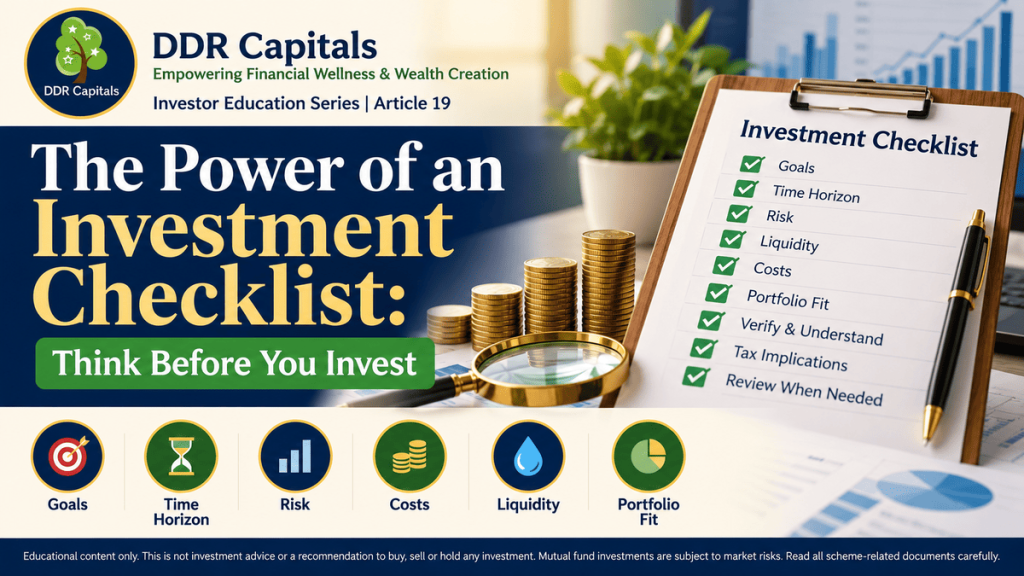
DDR Capitals – Investor Education Series | Article 19
Introduction: A Few Questions Can Prevent Costly Decisions
Imagine you are considering an investment. Someone tells you that a fund has delivered impressive returns. A friend has already invested. Social media discussions are positive, and the opportunity appears attractive.
You feel tempted to act quickly.
But have you considered what the investment is designed to do? Does it fit your financial goals? Do you understand the risks? When might you need the money? What costs are involved? And what would make you reconsider your decision?
These questions may appear simple, but they can be overlooked when excitement, market movements or the fear of missing out influence our thinking.
This is where an investment checklist becomes valuable.
An investment checklist is a structured set of questions that helps you examine an investment before committing your money. It encourages you to pause, gather relevant information, assess suitability and identify unanswered questions.
The objective is not to eliminate every investment risk. No checklist can guarantee returns or prevent every mistake. Its purpose is to help investors make more informed, consistent and deliberate decisions.
The power of an investment checklist lies not in predicting what will happen next, but in helping you think clearly before you act.
1. Why Investors Need an Investment Checklist
Many investment mistakes do not happen because investors lack intelligence. They happen because decisions are made without considering all the relevant factors.
An investor may select a fund because it recently outperformed its peers. Another may invest in a product without understanding its liquidity restrictions. Someone else may commit money intended for a near-term expense to an investment whose value can fluctuate significantly.
Each decision may appear reasonable when viewed from a single perspective. The problem emerges when the investor considers the entire financial picture.
An investment checklist helps address five common weaknesses.
It creates consistency. Instead of evaluating one investment carefully and another impulsively, you follow a similar process each time.
It reduces emotional decisions. A written set of questions can create a pause between feeling excited about an opportunity and committing money.
It identifies missing information. If you cannot explain how an investment works, what it costs or how you might access your money, you know what to investigate before proceeding.
It improves comparisons. A checklist helps you compare investments on relevant factors rather than focusing exclusively on recent returns.
It creates accountability. Recording why you invested can help you evaluate the original reasoning later, rather than judging the decision solely by short-term performance.
A checklist does not replace research, professional guidance where appropriate or the official documents governing an investment. It provides a disciplined starting point for those activities.
2. Question One: What Is the Purpose of This Investment?
Before asking how much an investment might earn, ask what role it is supposed to play in your financial life.
Are you investing for retirement, a child’s education, a home purchase, financial independence, future income or long-term wealth creation?
Different objectives can require different investment approaches.
For example, money needed for a planned expense in the near future has a different purpose from money that you do not expect to need for many years. An investment that may fluctuate considerably could be difficult to rely on for an expense with a fixed payment date.
Clarify three things:
- The goal: What future need is this money intended to support?
- The amount: Approximately how much money may be required?
- The deadline: When will you need to access the funds?
If you cannot explain the purpose of an investment in one or two sentences, pause and clarify the objective before proceeding.
An investment should serve a financial purpose. It should not be selected simply because it is popular, recently successful or frequently discussed.
3. Question Two: Does the Investment Match Your Time Horizon?
Your time horizon is the period between investing and when you expect to need the money.
It matters because investments differ in their potential volatility, liquidity and suitability for different periods.
Consider two hypothetical investors.
Investor A needs money for a home down payment in 18 months.
Investor B is investing for a retirement goal that is 20 years away.
Even if both investors are attracted to the same investment, their circumstances are different. Investor A may have limited time to recover from an unfavourable market movement. Investor B has a longer horizon, although still faces investment risk and uncertainty.
A longer time horizon does not make every risky investment suitable. Similarly, a shorter horizon does not automatically determine which product should be selected. The nature of the goal, the investor’s capacity for loss and the characteristics of the investment all matter.
Before investing, ask:
- When will I need this money?
- Is the date flexible or fixed?
- What happens if the investment value falls when I need the funds?
- Could I meet the goal if the investment takes longer than expected to recover?
- Are there any lock-in periods, redemption restrictions or exit charges?
A useful principle: The closer a financial goal gets, the more important it becomes to consider when and how the money will be available.
4. Question Three: Do I Understand the Investment and Its Risks?
Never invest solely because someone describes an opportunity as safe, promising or suitable for everyone.
Every investment has characteristics that need to be understood. These may include market risk, credit risk, interest-rate risk, liquidity risk, concentration risk, currency risk or other product-specific risks.
Not every risk applies to every investment. The relevant risks depend on the product, its underlying assets, its structure and its terms.
Before proceeding, ask:
- What does this investment actually own or invest in?
- How is its value determined?
- What factors could cause its value to fall?
- Is there a possibility of losing part or all of my capital?
- Are returns fixed under legally enforceable terms, variable, or dependent on performance?
- Do I understand the conditions attached to any stated or projected return?
- What are the important limitations and risks disclosed in the official documents?
Be particularly careful when a product is described as offering high returns with little or no risk. Higher potential returns often involve additional risks, restrictions or uncertainties that deserve careful examination.
A product’s past performance is not a guarantee of future results. Historical returns should be considered alongside the investment’s objectives, risks, costs and consistency with your circumstances.
If you cannot explain the basic risks in your own words, gather more information before investing.
5. Question Four: Can I Afford the Risk?
Understanding the risk of an investment is only one part of the decision. You must also consider your ability and willingness to bear that risk.
These are related but different concepts.
Risk tolerance refers to your psychological comfort with uncertainty and potential losses.
Risk capacity refers to your financial ability to withstand losses without seriously affecting essential expenses or important financial goals.
An investor may be comfortable with market fluctuations but have limited capacity for loss because of upcoming expenses, high financial commitments or an uncertain income.
Another investor may have the financial capacity to withstand volatility but feel anxious when the portfolio declines.
Both situations matter.
Before investing, consider:
- Is my income stable or variable?
- Do I have sufficient emergency reserves for my circumstances?
- Are there significant upcoming expenses?
- Do I have loans or other financial commitments?
- Would a substantial fall in this investment affect an essential goal?
- How might I react if the investment underperformed expectations?
Imagine investing a substantial amount in a volatile asset and then finding it difficult to sleep because its value has fallen. The problem may not be limited to the investment itself. The amount invested, the portfolio’s overall allocation or the investment’s role in your financial life may also need reconsideration.
A checklist cannot determine your risk profile by itself. However, it can help you recognise when a decision requires a more complete assessment.
6. Question Five: Have I Considered Liquidity and Access to My Money?
Liquidity describes how readily an investment can be converted into cash, taking account of the applicable conditions and potential costs.
This is important because an investment can have an attractive long-term objective but still be unsuitable for money you may need urgently.
Different products have different liquidity arrangements. Some may permit redemption on working days subject to applicable rules. Others may have lock-in periods, notice requirements, redemption windows, limited secondary-market liquidity or other restrictions.
Before investing, ask:
- Can I access my money when I need it?
- Are there lock-in periods or withdrawal restrictions?
- Could I face exit loads, penalties or other costs?
- Is the ability to sell dependent on finding a buyer?
- Could settlement take longer than I expect?
- Would an unexpected expense force me to sell at an unfavourable time?
Do not assume that every investment can be sold immediately at a fair price.
Liquidity deserves particular attention when considering investments with lock-in periods, less active secondary markets, complex structures or restrictions on redemption.
The relevant question is not merely whether you can eventually access the money. It is whether the investment’s liquidity arrangements fit the timing of your financial needs.
7. Question Six: What Will This Investment Cost Me?
Costs can influence the amount of wealth an investor ultimately retains.
Depending on the product, costs may include expense ratios, management fees, distribution-related charges where applicable, transaction charges, exit loads, brokerage, taxes and other expenses.
The structure and applicable charges vary across investment products. Some costs may be visible immediately, while others may be described in detailed documents or become relevant only under particular conditions.
Before investing, ask:
- What charges apply when I invest?
- What ongoing costs will I bear?
- Are there exit charges or transaction costs?
- How do the costs affect the investment’s net outcome?
- Are there tax implications I should understand?
- Have I compared costs alongside risks, features and suitability?
Do not select an investment merely because it has the lowest cost. Equally, do not assume that a higher-cost product must deliver a better outcome.
Costs should be assessed in the context of the product’s features, investment approach, service arrangements and suitability for the investor.
Where two alternatives are otherwise comparable, understanding their cost differences can make the comparison more meaningful.
8. Question Seven: Am I Diversified, or Am I Concentrating Too Much Risk?
Holding several investments does not necessarily mean that your portfolio is well diversified.
You may own multiple mutual funds that hold many of the same securities. You may have investments spread across several providers but concentrated in the same sector, asset class or underlying risk factor.
Diversification involves examining how different investments contribute to the overall portfolio and whether their risks overlap.
Before adding an investment, ask:
- What does it add to my existing portfolio?
- Do I already have substantial exposure to similar assets?
- Am I becoming too dependent on one company, sector, issuer or asset class?
- Could several of my investments decline for the same underlying reason?
- Does this investment support my overall asset allocation?
For example, adding another fund that holds many of the same securities as your existing funds may increase the number of investments without materially improving diversification.
Similarly, an investment that appears different in name or structure may still introduce risks that are already present elsewhere in the portfolio.
The objective is not to own as many investments as possible. It is to understand the combined exposures and ensure that the overall portfolio remains aligned with your goals and circumstances.
9. Question Eight: Have I Verified the Product, Provider and Documents?
An attractive presentation is not a substitute for verification.
Before committing money, confirm that you understand the product and have accessed the relevant official information. The checks required will vary according to the type of investment and the jurisdiction in which it is offered.
For a mutual fund, this may involve reviewing the scheme information document, key information memorandum, factsheet and applicable disclosures.
For bonds or other securities, relevant documents may include the offer document, issuer disclosures, credit-risk information and terms governing repayment and trading.
For alternative or specialised investment structures, review the applicable offering documents, eligibility requirements, fees, liquidity terms, valuation arrangements and risk disclosures.
Ask yourself:
- Is the provider or intermediary appropriately registered or authorised for the activity, where required?
- Have I verified the product through reliable and official sources?
- Do I understand who manages or issues the investment?
- Are the investment terms consistent with the information presented to me?
- Are the risks, fees and restrictions clearly disclosed?
- Have I checked the relevant documentation rather than relying only on a verbal explanation?
Be cautious if someone pressures you to transfer money urgently, promises assured high returns without a credible basis, avoids providing documentation or asks you to transfer funds to an unrelated personal account.
Never share passwords, one-time passcodes or other authentication credentials to facilitate an investment.
Verification is not a formality. It is an important part of protecting yourself from misinformation, unsuitable products and potential fraud.
10. Question Nine: Have I Considered Taxes and the Impact on My Overall Finances?
An investment’s headline return does not necessarily equal the amount you ultimately retain.
Tax treatment may depend on the type of investment, holding period, transaction, investor’s circumstances and applicable law. Rules can change, and different products may be treated differently.
Before investing, ask:
- What tax treatment may apply to income, gains or distributions?
- Are there relevant holding-period conditions?
- Could a transaction trigger a tax liability?
- Are there reporting or documentation requirements?
- Does the investment affect my broader financial position?
Tax considerations should not become the only reason for choosing an investment. A potential tax benefit does not automatically make a product suitable for your goals, risk tolerance, liquidity needs or overall portfolio.
Where the tax treatment is complex or the amount involved is material, consider obtaining appropriate professional tax guidance.
The objective is to understand the investment’s overall financial implications rather than focusing on one attractive feature in isolation.
11. Question Ten: What Would Make Me Review This Investment?
An investment decision should have a clear rationale. It should also have identifiable circumstances that would justify reviewing that rationale.
Without these criteria, investors may react to every market movement—or ignore important changes because they have become emotionally attached to the original decision.
Before investing, consider what could reasonably prompt a review.
Examples include:
- A material change in your financial goals or time horizon.
- A significant change in income, expenses or family responsibilities.
- A change in the investment’s objectives, strategy, management or terms.
- A deterioration in relevant credit or financial conditions.
- A change in liquidity arrangements or applicable regulations.
- A meaningful change in the investment’s role within your portfolio.
- Evidence that the original investment rationale is no longer valid.
A review does not automatically mean selling.
It means examining whether the investment continues to serve its intended purpose and whether any action is warranted after considering the available facts.
Avoid setting arbitrary review triggers based only on daily market movements. Equally, do not assume that a long-term investment should never be reviewed.
A disciplined investor knows why the investment was selected and what information would justify reassessing it.
12. The Five-Minute Investment Checklist
You do not need a complicated spreadsheet for every investment decision. Start with a short checklist that you can apply consistently.
Before committing money, answer these questions:
Purpose
- Can I clearly explain the financial goal this investment supports?
Time horizon
- Does the investment’s time horizon fit when I expect to need the money?
Risk
- Do I understand the main risks and the possibility of losing money?
Risk capacity
- Can my finances withstand an unfavourable outcome without seriously harming essential goals?
Liquidity
- Do I understand when and how I can access my money?
Costs and taxes
- Have I checked the relevant charges, costs and tax implications?
Portfolio fit
- Do I understand how this investment fits with my existing investments?
Verification
- Have I checked the relevant provider, product information and official documents?
Review
- Do I know what circumstances could require me to reassess this investment?
Decision
- Can I explain why I am investing without relying solely on recent returns, social pressure or fear of missing out?
If you cannot answer an important question, do not treat the gap as a reason to guess. Identify the missing information and obtain it before proceeding.
A checklist is most useful when it encourages you to investigate unanswered questions—not when it becomes a box-ticking exercise.
13. What Should You Do When an Answer Is Unclear?
One of the most valuable outcomes of an investment checklist is discovering what you do not yet understand.
Suppose an investment appears attractive, but you cannot determine how quickly you can redeem it. Or you understand its historical returns but cannot explain the principal risks. Perhaps the fees are unclear, or you cannot establish whether the product fits your intended goal.
These are not reasons to feel embarrassed. They are signals that further investigation is needed.
Use a simple three-step process.
Step 1: Identify the gap. Write down the specific question you cannot answer.
Step 2: Find reliable information. Review official documents and disclosures, contact the relevant provider or intermediary, or seek qualified professional guidance where appropriate.
Step 3: Reassess the decision. Proceed only when you have enough information to understand the material features and risks and determine whether the investment fits your circumstances.
You do not have to invest immediately simply because an opportunity is available.
If the decision cannot be evaluated properly under time pressure, stepping back may be more prudent than rushing forward.
A missed opportunity is not necessarily a financial loss. An inadequately understood commitment can have consequences long after the excitement of the initial decision has passed.
14. Five Investment Checklist Mistakes to Avoid
Even a good checklist can be used poorly. Watch out for these common mistakes.
Mistake 1: Treating the checklist as a guarantee. Completing every item does not eliminate market, credit, liquidity or other risks.
Mistake 2: Focusing only on returns. Strong historical performance cannot replace an assessment of risk, costs, liquidity and suitability.
Mistake 3: Ignoring uncomfortable answers. A checklist has little value if investors dismiss concerns simply because they like the investment.
Mistake 4: Using the same assumptions forever. Income, financial responsibilities, market conditions and product terms can change. Review the relevant factors when circumstances warrant it.
Mistake 5: Confusing a checklist with professional assessment. Complex investments or financial circumstances may require more detailed analysis than a short set of questions can provide.
The purpose is not to create paperwork. It is to improve the quality of your decision.
15. A Simple Example: Two Investors, One Investment
Consider two hypothetical investors who are both attracted to the same investment after hearing about its recent performance.
Investor A has a long-term goal, sufficient liquidity for near-term expenses and a financial position that may allow them to tolerate fluctuations. Investor B expects to use the money for a major expense within a year and has limited reserves for unexpected costs.
Both investors may find the investment interesting. However, their financial circumstances and the role of the money are different.
A checklist encourages each investor to examine the purpose, time horizon, risk, liquidity and portfolio fit before proceeding.
Investor A still needs to understand the product and determine whether it is appropriate for their circumstances. Investor B may discover that the investment’s liquidity or potential volatility conflicts with the intended use of the money.
The lesson is not that one investor should automatically invest and the other should not. The lesson is that the same investment opportunity can have different implications for different investors.
A decision should be evaluated in the context of the person making it—not just the performance figures attached to the product.
16. How an Investment Checklist Fits Into Your Overall Financial Strategy
An investment checklist is one part of a broader process.
It works best alongside clear financial goals, an understanding of your income and responsibilities, an assessment of risk tolerance and capacity, appropriate diversification and periodic portfolio reviews.
Think of the process as a sequence:
Define the goal → Understand your circumstances → Evaluate the investment → Verify the details → Make an informed decision → Record the rationale → Review when warranted.
This process can also help you organise your investment records.
For each investment, consider recording:
- The goal it supports.
- The date and amount invested.
- The main reasons for selecting it.
- The key risks and liquidity conditions.
- The costs and relevant documents reviewed.
- The circumstances that could trigger a review.
These notes can be valuable months or years later, when you need to understand why the original decision was made.
They can also help distinguish between a sound decision that experienced an unfavourable outcome and a decision that was poorly evaluated from the beginning.
Investment outcomes are uncertain. The quality of your decision-making process is something you can work to improve.
Key Takeaways
- An investment checklist encourages disciplined thinking before money is committed.
- Start with the financial purpose of the investment, not its recent returns.
- Match the investment’s time horizon and liquidity characteristics to your needs.
- Understand the principal risks before deciding whether you can bear them.
- Consider risk tolerance and risk capacity as separate but related factors.
- Examine costs and relevant tax implications alongside potential benefits.
- Evaluate how the investment fits into your overall portfolio.
- Verify the product, provider, terms and official documentation.
- Define circumstances that could justify reviewing the investment.
- Treat unanswered questions as a signal to investigate, not a reason to guess.
- Remember that completing a checklist cannot guarantee returns or eliminate risk.
- Apply the same disciplined process consistently, while adapting it to the investment and your circumstances.
Final Thought: Think Before You Invest
Investment opportunities will always compete for your attention. Markets will rise and fall, products will be promoted and new trends will emerge.
You cannot control every market outcome. You can, however, build a more disciplined process for evaluating decisions.
Before your next investment, pause and ask yourself: Do I understand what I am investing in, why it belongs in my financial plan, what could go wrong and what would make me review the decision?
If you cannot answer those questions, take the time to find out.
Think before you invest. A few well-considered questions today can help you avoid decisions you may struggle to justify tomorrow.
Continue Your Investor Education Journey
Explore more articles in the DDR Capitals Investor Education Series:
- Article 14: The Investment Mistakes That Look Smart at First
- Article 15: One Portfolio, Many Goals — How to Organise Your Investments
- Article 16: When Should You Review Your Mutual Fund Portfolio?
- Article 17: The 5 Questions to Ask Before You Invest in Any Fund
- Article 18: Why Your Income Should Change the Way You Invest
About the Author

Mrs. Mansi Radadia , Operations & Compliance Officer, DDR Capitals. Contributor – Investor Education Series. With a strong focus on investor servicing, operational excellence and regulatory compliance, she is committed to helping investors navigate their financial journey with confidence. She believes successful wealth creation is built on discipline, informed decision-making and staying invested through changing market cycles. She actively supports investor education initiatives and encourages investors to explore Investor Education Resources. Through the DDR Capitals Investor Education Series, Mansi Radadia contributes educational content designed to help investors understand important concepts, recognize common behavioural mistakes and approach investing with greater awareness and discipline.
About DDR Capitals
DDR Capitals is an AMFI-registered Mutual Fund Distributor (ARN-113051) focused on investor education and the distribution of investment and financial products within the scope of its applicable registrations and authorisations.
Our Investor Education Series aims to help individuals understand investment concepts, recognise risks and develop more informed financial habits.
DDR Capitals – Empowering Financial Wellness & Wealth Creation
Disclaimer
This article is intended for general educational and informational purposes only. It is not investment advice or a recommendation to buy, sell or hold any investment product or security. Investments involve risks, including possible loss of capital. Product suitability depends on an investor’s individual financial circumstances, objectives, time horizon and risk profile. Readers should review the relevant official documents and disclosures carefully and seek appropriate professional guidance where necessary. Mutual fund investments are subject to market risks. Read all scheme-related documents carefully.
DDR Capitals is an AMFI-registered Mutual Fund Distributor and does not provide investment advisory services under the SEBI (Investment Advisers) Regulations, 2013.