
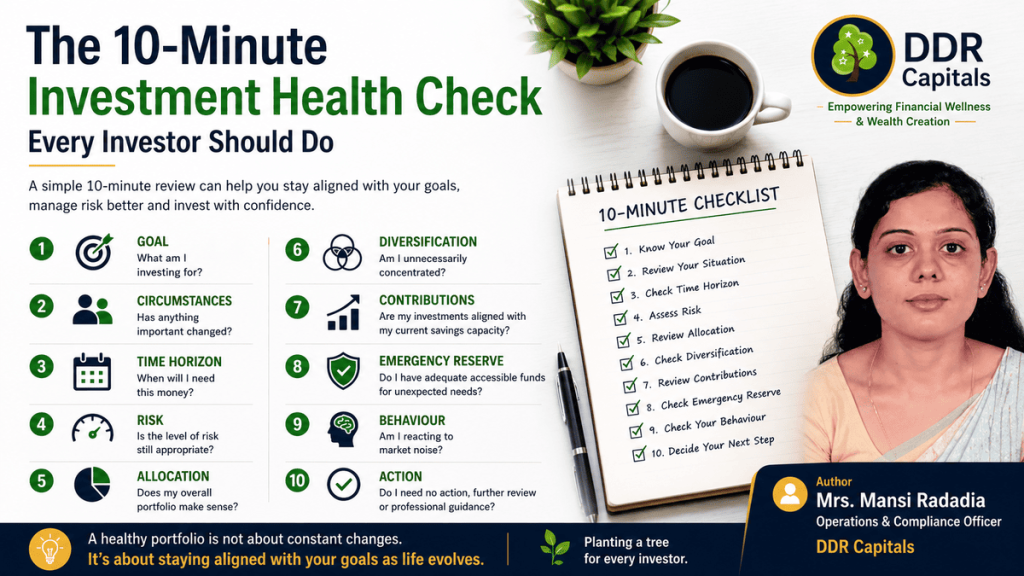
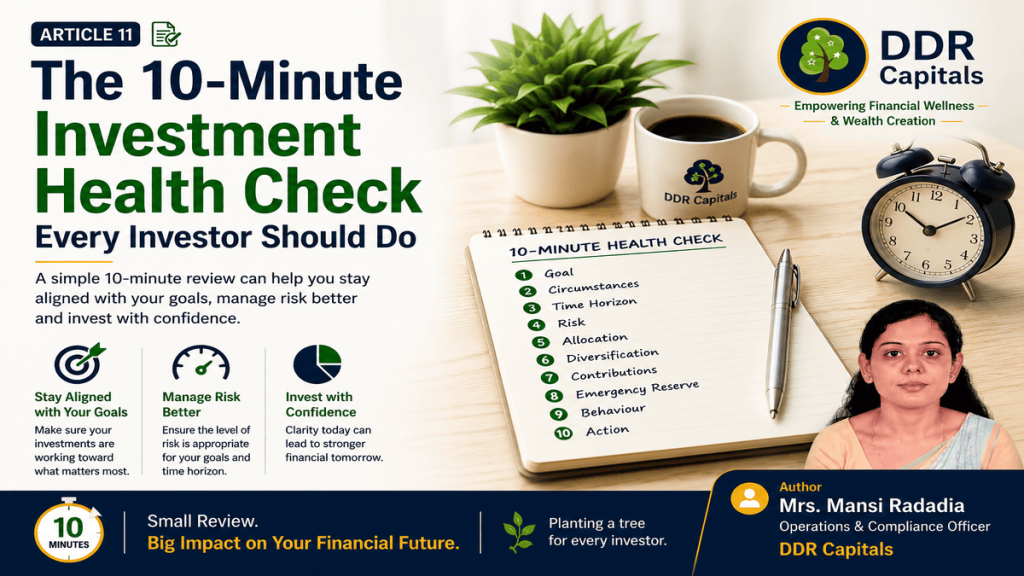
Your portfolio does not need constant attention. But it does deserve an occasional health check.
Investing is often treated as a “set it and forget it” activity.
While long-term investing does not require investors to watch their portfolios every day, completely ignoring them for years can create its own problems.
A simple investment health check can reveal whether your portfolio is still aligned with your financial goals.
Goals change.
Income changes.
Family responsibilities change.
Risk capacity can change.
And investments that were appropriate several years ago may not necessarily remain appropriate today.
The good news is that a portfolio review does not have to take hours.
A simple 10-minute investment health check can help you step back, understand where you stand and identify whether anything deserves a closer look.
This is not about checking daily returns. It is about checking whether your investments are still connected to your financial life.
Most investors review their portfolio when markets rise sharply or fall suddenly. But a healthy investment portfolio deserves a quick check even when markets appear calm.
This investment health check takes only a few minutes but can highlight areas that deserve closer attention.
Minute 1: What Are You Investing For?
Start with the most important question:
What is this money meant to achieve?
Is it for:
- Retirement?
- Children’s education?
- Buying a home?
- A future business requirement?
- A financial safety net?
- Long-term wealth creation?
If you cannot clearly identify the purpose of an investment, it becomes difficult to judge whether the investment is doing its job.
A portfolio should ultimately serve a purpose.
Don’t start with returns. Start with the goal.
Minute 2: Has Your Goal Changed?
Your investments may still be the same, but your life may not be.
Ask yourself:
Has anything changed since I originally invested?
Perhaps your income has increased.
Perhaps a major financial responsibility has appeared.
Perhaps your investment horizon has become shorter.
Perhaps a goal has become more important—or less important.
A change in circumstances does not automatically mean you should change your investments.
It does mean the situation deserves a fresh look.
Minute 3: Check Your Time Horizon
Different goals have different timelines.
Money needed soon should generally be evaluated differently from money intended for a goal many years away.
Ask:
When will I actually need this money?
Then compare that time horizon with the nature of your investments.
The closer a financial goal becomes, the more important it is to understand the level of risk attached to money earmarked for that goal.
Time horizon should be part of every investment conversation.
TIME HORIZON MATTERS
A long-term goal and a short-term requirement should not automatically be treated the same way.
Minute 4: Understand Your Risk — Not Just Your Returns
Many investors ask:
“How much did my investment return?”
A better question is:
“How much risk am I taking to pursue my goal?”
Returns should never be viewed in isolation.
Two portfolios can generate similar returns while carrying very different levels of risk.
Ask yourself:
- Am I comfortable with the level of fluctuations?
- Would I panic if the portfolio declined temporarily?
- Has my ability to take risk changed?
- Is the current level of risk appropriate for my goal and time horizon?
Knowing your own behaviour is important.
Your risk profile is not simply a number on a form. Your financial circumstances and ability to withstand losses also matter.
Minute 5: Look at the Big Picture
Don’t review every investment separately.
First look at the overall portfolio.
How much is invested across different asset classes?
Are you heavily concentrated in one category?
Do several investments actually have similar underlying exposures?
A portfolio containing many funds is not necessarily well diversified.
More investments do not automatically mean more diversification.
The objective is not to own everything.
The objective is to build a portfolio that is appropriately aligned with your goals, risk profile and time horizon.
MORE FUNDS ≠ MORE DIVERSIFICATION
Diversification is about understanding exposure, not simply counting investments.
Minute 6: Check for Unnecessary Overlap
This is one of the easiest things to overlook.
An investor may hold several funds believing that each one adds something different.
But some investments may have significant overlap in their underlying holdings or market exposure.
Ask:
Do I understand why I own each investment?
If the answer is “I bought it because someone recommended it” or “it was performing well at the time,” it may deserve a closer review.
Every investment should have a reason for being in the portfolio.
Minute 7: Review Your SIPs and Contributions
If you invest regularly, check whether your contribution level still makes sense.
Ask:
- Has my income changed?
- Has my savings capacity increased?
- Have my financial priorities changed?
- Am I still investing consistently toward my goals?
An increase in income can sometimes create an opportunity to increase investments gradually.
At the same time, investors should avoid increasing contributions simply because markets are rising or because of short-term excitement.
Investment contributions should be connected to financial capacity and goals—not market emotions.
WHEN LIFE CHANGES, REVIEW YOUR INVESTMENT PLAN.
Income → Goals → Savings Capacity → Investment Strategy
Your investment plan should evolve as your financial circumstances evolve.
Minute 8: Check Your Emergency Reserves
A long-term investment portfolio should not necessarily be treated as an emergency fund.
Ask:
If an unexpected expense arises tomorrow, do I have sufficient accessible money?
An adequate emergency reserve can reduce the need to disturb long-term investments because of an unexpected short-term requirement.
The appropriate amount depends on individual circumstances, income stability and financial responsibilities.
The important point is to distinguish between:
money for emergencies and money for long-term goals.
Minute 9: Ask Whether You Are Reacting to the Market
This is perhaps the most important behavioural question.
Am I considering a change because my financial situation has changed—or because the market has changed?
If the answer is the market, pause.
A falling market can create fear.
A rising market can create excitement.
Neither emotion should automatically determine a long-term investment decision.
Before making a change, understand the reason behind it.
BEFORE YOU CHANGE AN INVESTMENT, ASK WHY.
Is the decision based on:
Your Goal?
Your Time Horizon?
Your Risk Profile?
Your Financial Circumstances?
Or simply Market Noise?
Minute 10: Decide — No Action, Review or Rebalance
After completing the health check, don’t feel compelled to make a change.
There are only three broad outcomes:
1. No Action Required
Your goals, circumstances, risk profile and investment strategy remain aligned.
Continue with the plan.
2. Further Review Required
Something has changed, but you need more information before making a decision.
Take time to understand the issue.
3. Portfolio Adjustment May Be Required
Your goals, circumstances, risk profile or asset allocation may have changed sufficiently to warrant a review and possible adjustment.
This is where professional guidance can be useful.
A health check is not successful because it produces changes. It is successful because it produces clarity.
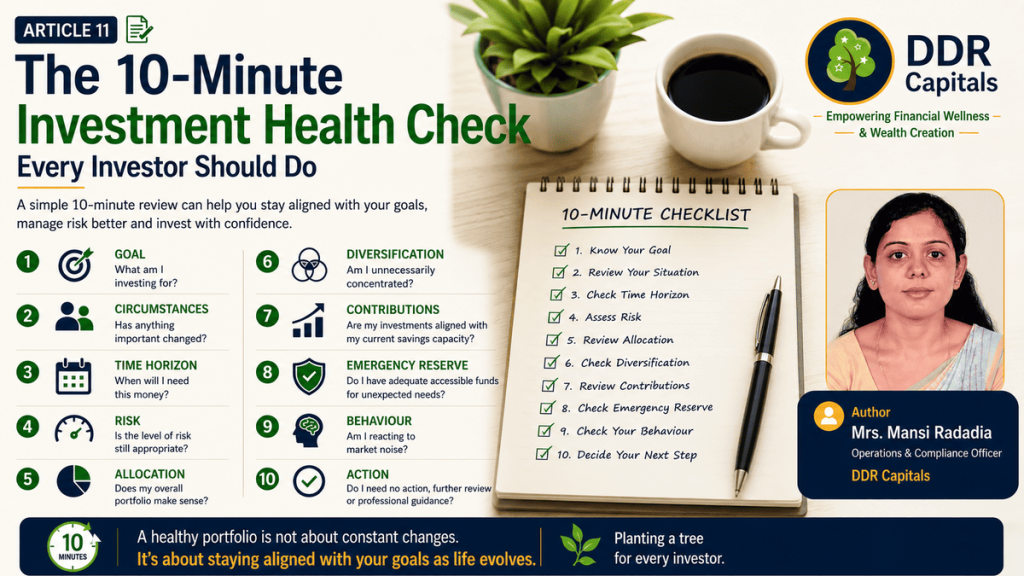
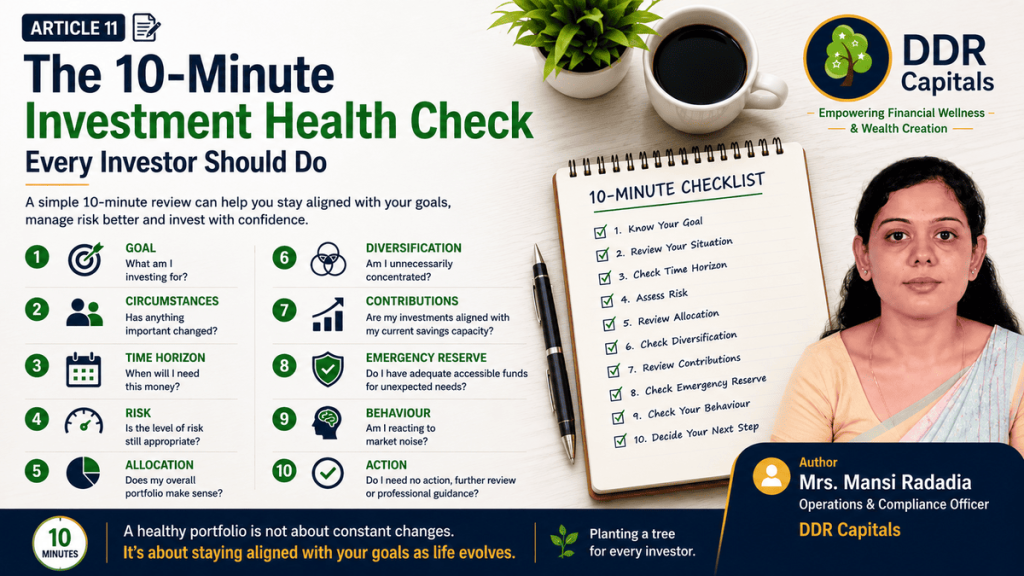
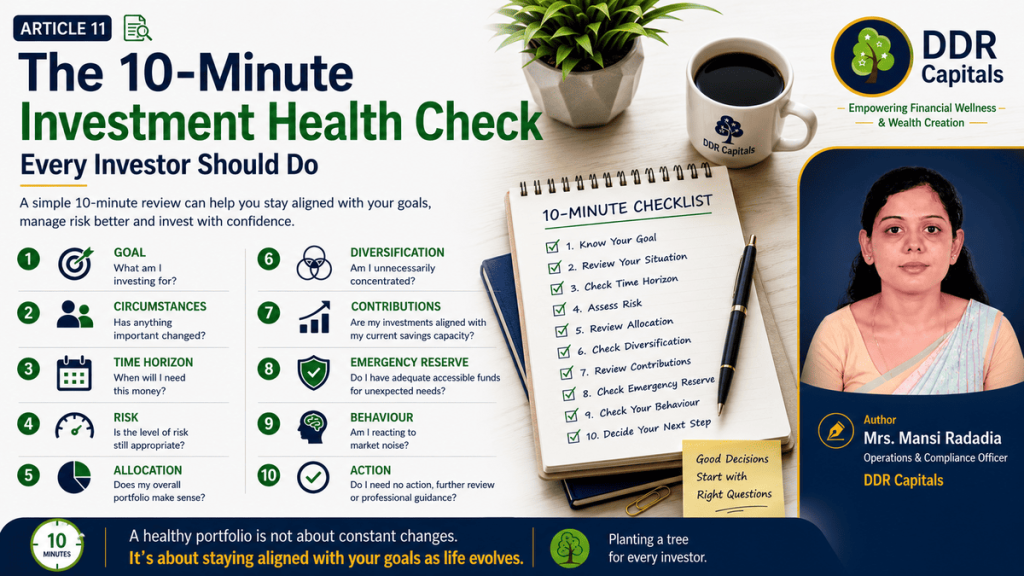
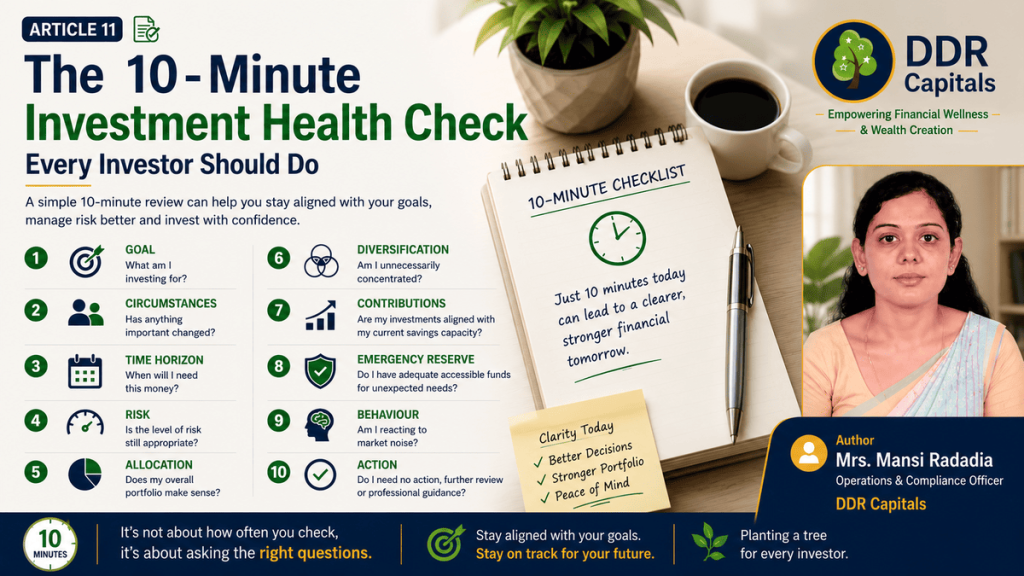
Your 10-Minute Investment Health Check
Save this checklist and revisit it periodically:
1. Goal — What am I investing for?
2. Circumstances — Has anything important changed?
3. Time Horizon — When will I need this money?
4. Risk — Is the level of risk still appropriate?
5. Allocation — Does my overall portfolio make sense?
6. Diversification — Am I unnecessarily concentrated?
7. Contributions — Are my investments aligned with my current savings capacity?
8. Emergency Reserve — Do I have adequate accessible funds for unexpected needs?
9. Behaviour — Am I reacting to market noise?
10. Action — Do I need no action, further review or professional guidance?
Key Takeaways
- A portfolio does not need to be monitored every day.
- It does deserve periodic review as financial circumstances change.
- Start with goals, not investment returns.
- Time horizon and risk should be considered together.
- Owning more funds does not automatically mean better diversification.
- Every investment should have a clear reason for being in the portfolio.
- Changes should be driven by goals and circumstances—not market noise.
- Sometimes the best investment decision is not to make an unnecessary change.
- The purpose of a portfolio health check is clarity, not constant activity.
Conclusion
Investing does not have to become complicated.
You don’t need to spend hours analysing your portfolio every week.
Sometimes, ten focused minutes are enough to ask the questions that matter.
What am I investing for?
Has my situation changed?
Is my portfolio still appropriate for my goals, time horizon and risk profile?
And perhaps most importantly:
Am I making this decision because my circumstances changed—or because the market did?
A healthy investment portfolio is not necessarily the one that changes the most.
It is the one that remains appropriately aligned with the investor’s goals as life evolves.
Take ten minutes.
Review the bigger picture.
Then decide whether anything actually needs to change.
Make this investment health check a regular part of your investment discipline.
Continue Your Investor Education Journey
Article 6: A Good Advisor Doesn’t Predict Markets
Article 7: The Hidden Behavior Gap in Wealth Creation
Article 8: Power of Compounding in Investing
Article 9: Why Market Volatility Is Not the Real Risk
Article 10: The Hidden Value of Financial Advice
Article 11: The 10-Minute Investment Health Check Every Investor Should Do
Disclaimer
This article is intended solely for investor education and awareness. It should not be construed as investment advice, a recommendation, or a solicitation to buy or sell any financial product or security. Investment decisions should be made after considering individual financial circumstances, investment objectives, time horizon and risk profile. Investors should consult an appropriately qualified professional where necessary.
About the Author
Mrs. Mansi Radadia
Operations & Compliance Officer
DDR Capitals
Contributor – Investor Education Series

Mrs. Mansi Radadia , Operations & Compliance Officer, DDR Capitals. Contributor – Investor Education Series. With a strong focus on investor servicing, operational excellence and regulatory compliance, she is committed to helping investors navigate their financial journey with confidence. She believes successful wealth creation is built on discipline, informed decision-making and staying invested through changing market cycles. She actively supports investor education initiatives and encourages investors to explore Investor Education Resources.