
Why investor returns are often lower than fund returns—and how disciplined investing closes the gap.
Introduction
Understanding the behavior gap in investing is one of the most important lessons for long-term wealth creation. Every investor wants higher returns, but many unknowingly reduce their own returns through emotional investment decisions.
Many spend hours comparing mutual funds, studying past performance and searching for the “best” investment.
Yet one of the biggest reasons investors underperform has nothing to do with fund selection.
It has everything to do with investor behaviour.
This invisible difference between the return generated by an investment and the return actually earned by the investor is known as the Behavior Gap. The behavior gap in investing affects millions of investors.
Understanding this concept may have a greater impact on your long-term wealth than finding the next top-performing mutual fund.
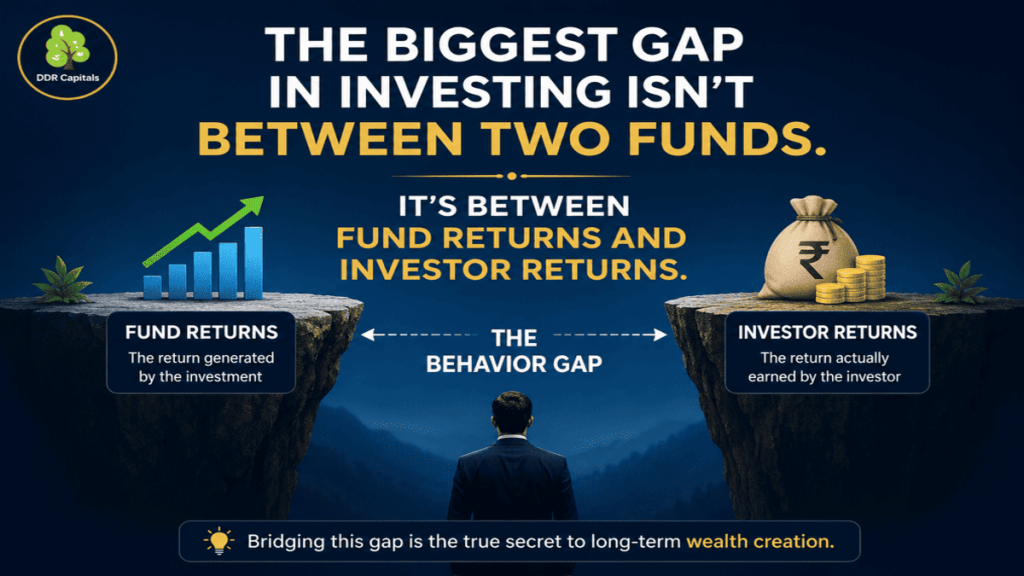
Why Does the Behavior Gap Exist?
A mutual fund simply follows its investment strategy.
It doesn’t panic.
It doesn’t get excited.
It doesn’t watch financial news.
It simply remains invested according to its objective.
Investors, however, often make emotional decisions.
They invest after markets rise.
They stop investing during market corrections.
They redeem investments when fear is highest.
Then they re-enter after markets recover.
Unfortunately, these decisions reduce long-term returns. Understanding the behavior gap in investing can improve long-term returns.
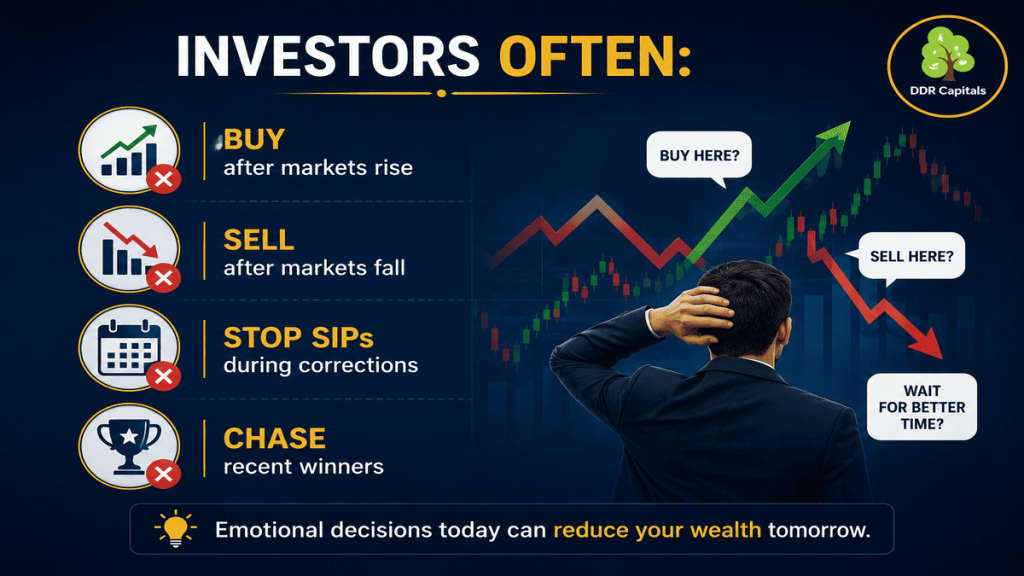
INVESTORS OFTEN:
❌ Buy after markets rise
❌ Sell after markets fall
❌ Stop SIPs during corrections
❌ Chase recent winners
Read more at Why Investors Stop SIPs at the Worst Possible Time
The Cost of Emotional Decisions
Consider two investors investing in exactly the same mutual fund.
Investor A:
• Continues SIPs regularly
• Ignores short-term volatility
• Remains invested for 15 years
Investor B:
• Stops SIPs during corrections
• Redeems during panic
• Waits for “better timing”
Although both selected the same fund, Investor A is likely to achieve significantly higher long-term wealth.
A Good Advisor Doesn’t Predict Markets
The difference is behaviour—not investment selection. Disciplined investing helps reduce the behavior gap in investing.
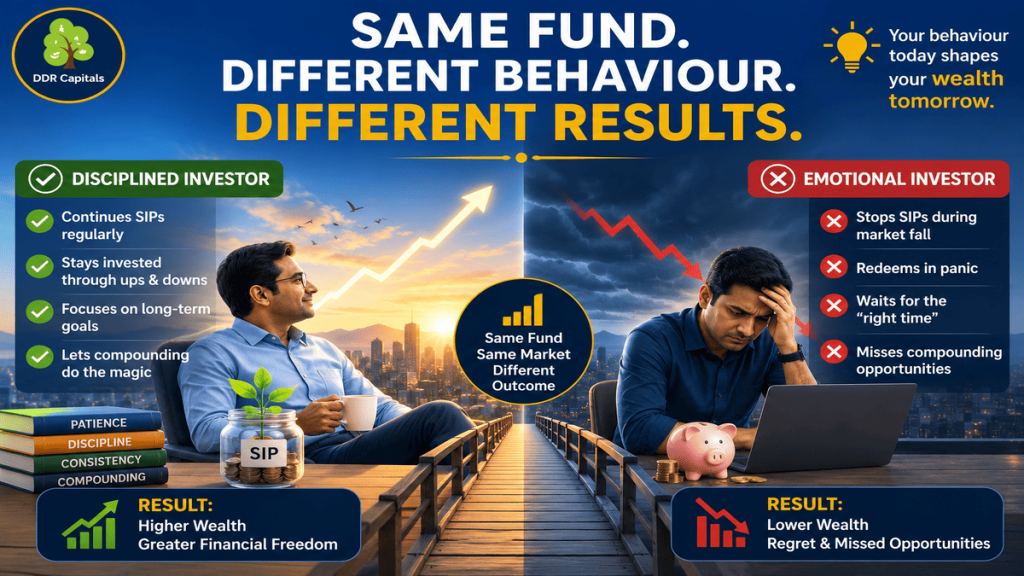
SAME FUND.
DIFFERENT BEHAVIOUR.
DIFFERENT RESULTS.
Successful Investors Think Differently
Disciplined investors understand that:
✔ Market corrections are temporary.
✔ Compounding requires patience.
✔ Volatility is part of investing.
✔ Time in the market matters more than timing the market.
Instead of reacting emotionally, they focus on their financial goals and investment discipline. For more education visit AMFI Investor Corner.
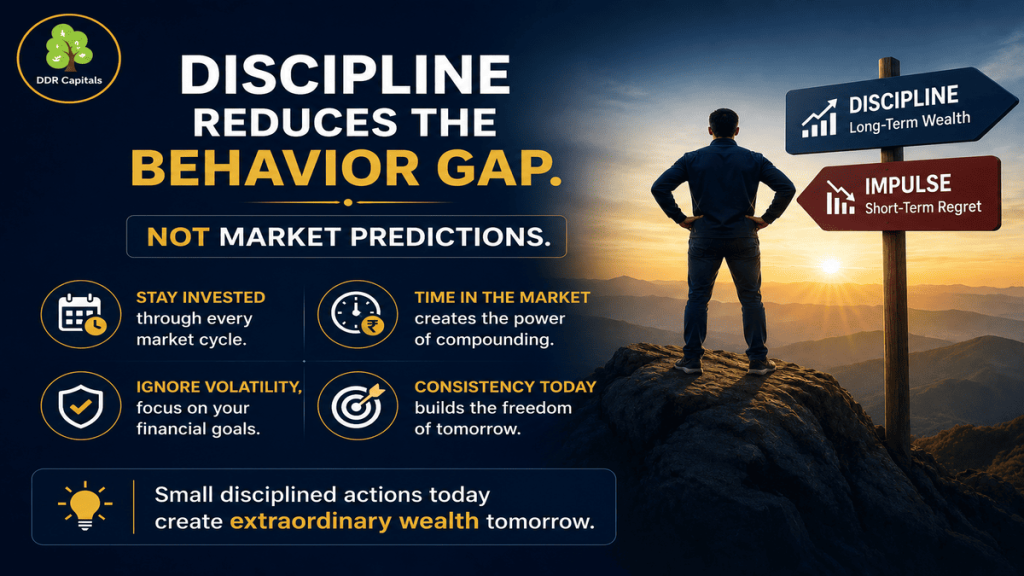
DISCIPLINE REDUCES THE BEHAVIOR GAP.
NOT MARKET PREDICTIONS.
How a Good Advisor Helps
he role of a financial advisor extends far beyond recommending investments.
A good advisor helps investors:
• Stay invested during uncertainty.
• Continue SIPs through market cycles.
• Avoid emotional decisions.
• Maintain focus on long-term goals.
Sometimes the greatest value an advisor provides is not choosing a better fund.
It is helping investors avoid behavioural mistakes that quietly reduce wealth over time. Financial advisors help investors overcome the behavior gap in investing.
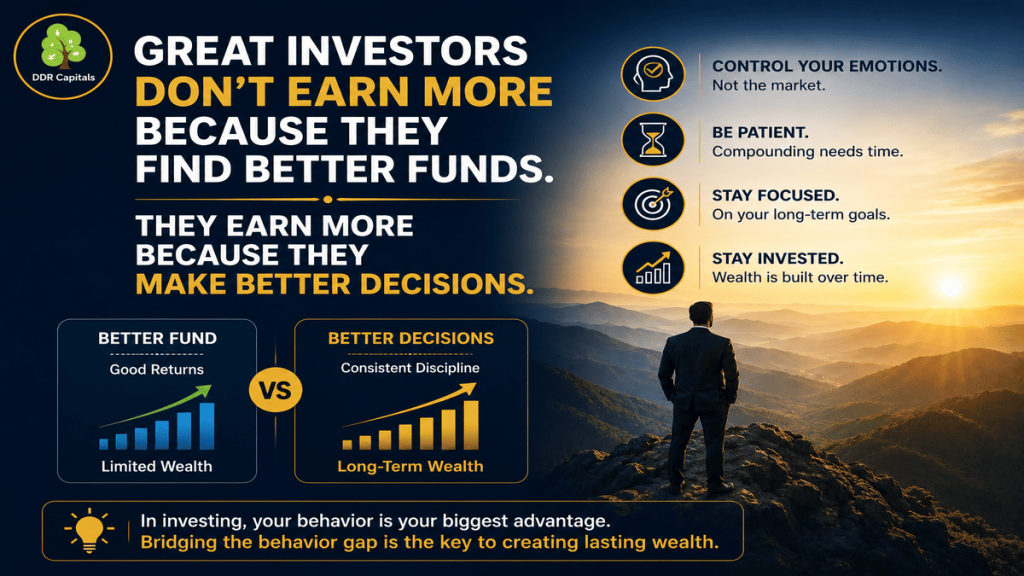
GREAT INVESTORS DON’T EARN MORE
BECAUSE THEY FIND BETTER FUNDS.
THEY EARN MORE
BECAUSE THEY MAKE BETTER DECISIONS.
Key Takeaways
✅ Fund returns and investor returns are often different.
✅ Emotional decisions create the behavior gap.
✅ Staying invested helps reduce the behavior gap.
✅ Discipline matters more than prediction.
✅ A good advisor helps investors stay on track.
Conclusion
The hidden behavior gap often goes unnoticed because it cannot be seen in fund fact sheets or performance charts.
It appears only in the choices investors make during uncertain times.
Long-term wealth is created not only by selecting quality investments but also by remaining disciplined through every phase of the market cycle.
The greatest investment advantage often comes from controlling behaviour rather than predicting markets.
The behavior gap in investing is often invisible because investors rarely compare their personal returns with the returns generated by the funds they own. Over long investment periods, even a few emotional decisions—such as stopping SIPs, delaying investments or redeeming during market corrections—can significantly reduce wealth. Staying disciplined throughout market cycles is one of the most effective ways to improve long-term investment outcomes.
The concept of the behavior gap has been widely discussed in behavioural finance and refers to the difference between an investment’s return and the return actually earned by investors because of their buying and selling decisions.
Call to Action
Have you ever delayed investing, stopped a SIP or sold investments because of market uncertainty?
What did you learn from that experience?
Share your thoughts in the comments or connect with DDR Capitals to discuss building long-term wealth through disciplined investing.
About the Author

Mrs. Mansi Radadia serves as Operations & Compliance Officer at DDR Capitals. With a strong focus on investor servicing, operational excellence and regulatory compliance, she is committed to helping investors navigate their financial journey with confidence. She believes successful wealth creation is built on discipline, informed decision-making and staying invested through changing market cycles. She actively supports investor education initiatives and encourages investors to explore Investor Education Resources.