
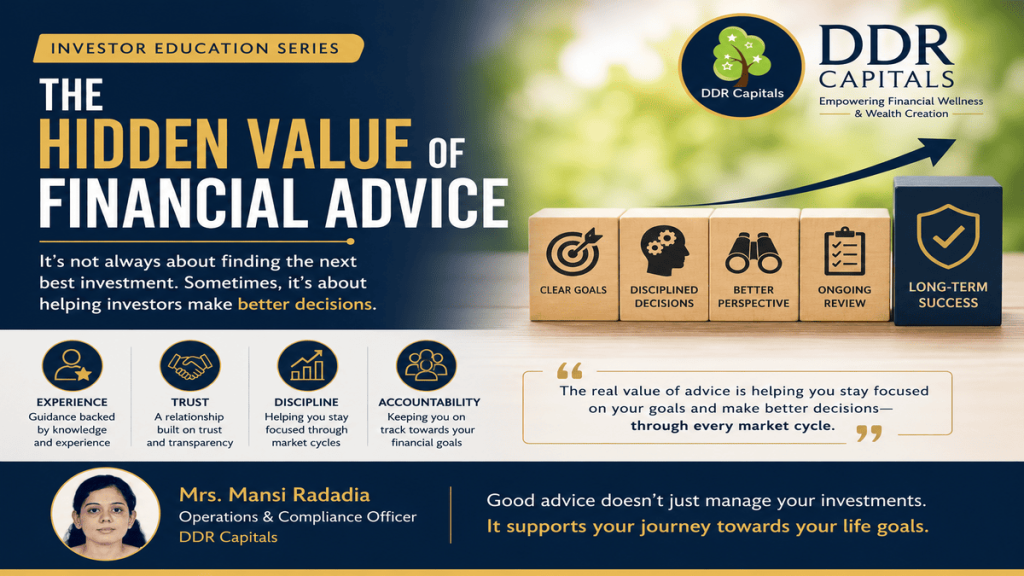
It isn’t always about finding the next best investment. Sometimes, it is about helping investors make better decisions.
When markets are rising, investing can appear simple.
When markets fall, the picture changes.
Uncertainty increases. Headlines become louder. Investors begin questioning their decisions. Some want to sell. Others want to stop investing until conditions improve. Some wait for the “right” time to enter again.
This is where the value of financial advice often becomes visible.
The role of a good advisor is not simply to identify an investment or predict what the market will do next. One of the most important contributions of professional guidance is helping investors remain focused on their financial goals while navigating uncertainty.
Advice Is More Than Investment Selection
Investment selection is only one part of the investing process.
A well-structured investment approach also requires understanding:
- The investor’s financial goals
- Investment time horizon
- Risk capacity and risk tolerance
- Asset allocation
- Liquidity requirements
- Existing investments
- Changing personal circumstances
- Behaviour during market cycles
The right investment on paper may not be the right investment for a particular investor.
Financial advice adds value by connecting investment decisions with the investor’s broader financial situation.
The Hidden Risk: Investor Behaviour
Markets do not make investment decisions.
Investors do.
During periods of uncertainty, emotions can influence those decisions.
Fear can encourage investors to sell after markets have already fallen. Optimism can encourage excessive risk-taking when markets have performed strongly.
Both reactions can move an investor away from the original investment plan.
A good advisor can provide an independent perspective when emotions are influencing the decision-making process.
This does not mean an advisor can remove market risk.
It means the investor does not have to face every market decision alone.
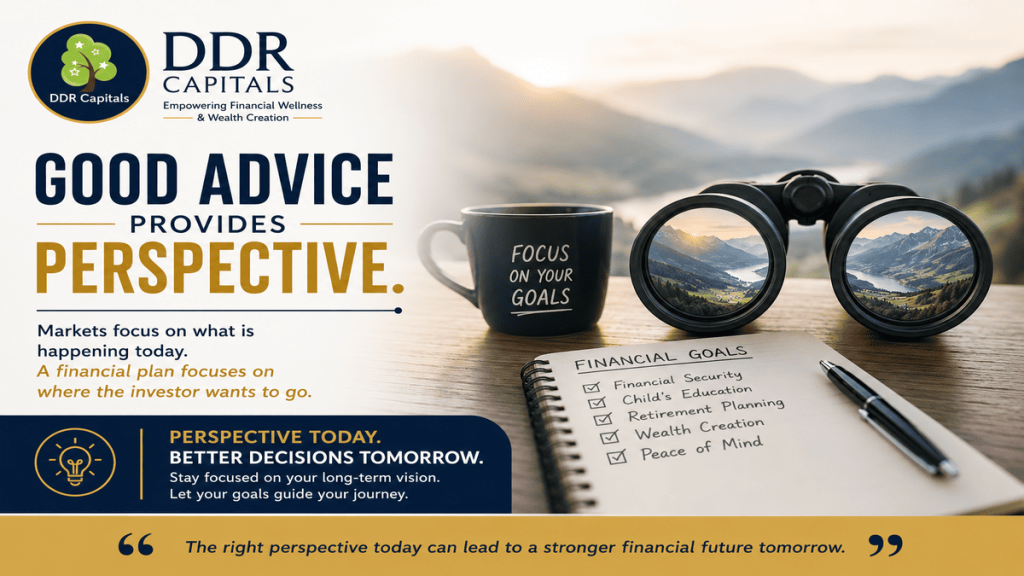
GOOD ADVICE PROVIDES PERSPECTIVE.
Markets focus on what is happening today.
A financial plan focuses on where the investor wants to go.
Guidance During Market Volatility
Market volatility is a normal part of investing.
The challenge is not eliminating volatility. The challenge is deciding what to do when volatility arrives.
Should an investor continue investing?
Should the asset allocation be reviewed?
Has the investor’s financial goal changed?
Has the investor’s risk capacity changed?
Or is the urge to act simply a reaction to short-term market movements?
These are not questions that can be answered by looking only at today’s market price.
They require context.
A good advisor helps bring that context into the decision-making process.
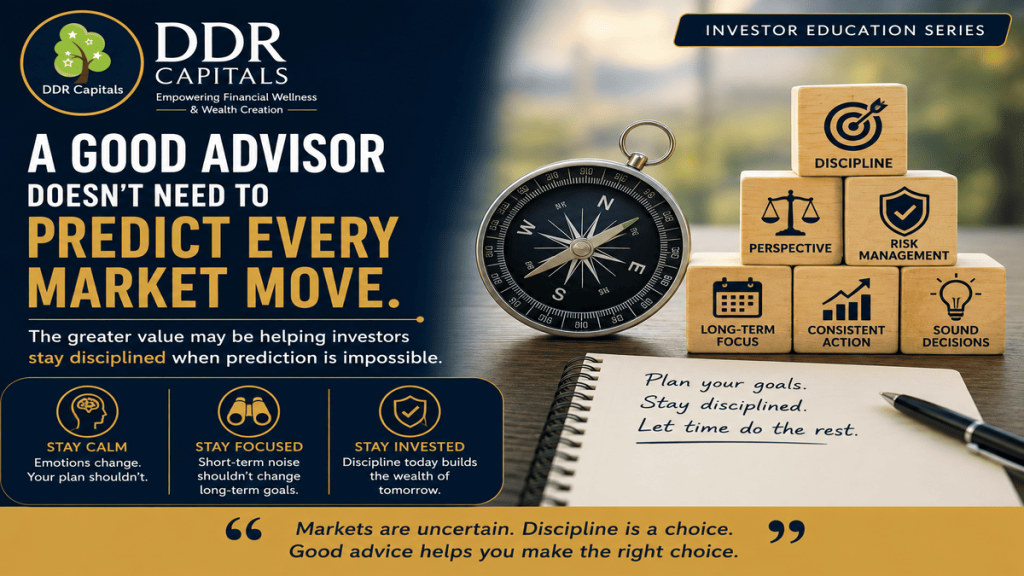
A GOOD ADVISOR DOESN’T NEED TO PREDICT EVERY MARKET MOVE.
The greater value may be helping investors stay disciplined when prediction is impossible.
Accountability Has Value
One of the less discussed benefits of financial advice is accountability.
Investors may create a financial plan with good intentions. But over time, priorities change, markets fluctuate and emotions appear.
Regular reviews can help investors ask important questions:
- Am I still on track toward my goals?
- Has my financial situation changed?
- Is my investment allocation still appropriate?
- Has my risk capacity changed?
- Do I need to rebalance?
- Am I making a decision because of my plan—or because of market noise?
This process creates a feedback loop between the investor’s goals and the investment strategy.
The objective is not to make more decisions.
It is to make better-informed decisions.
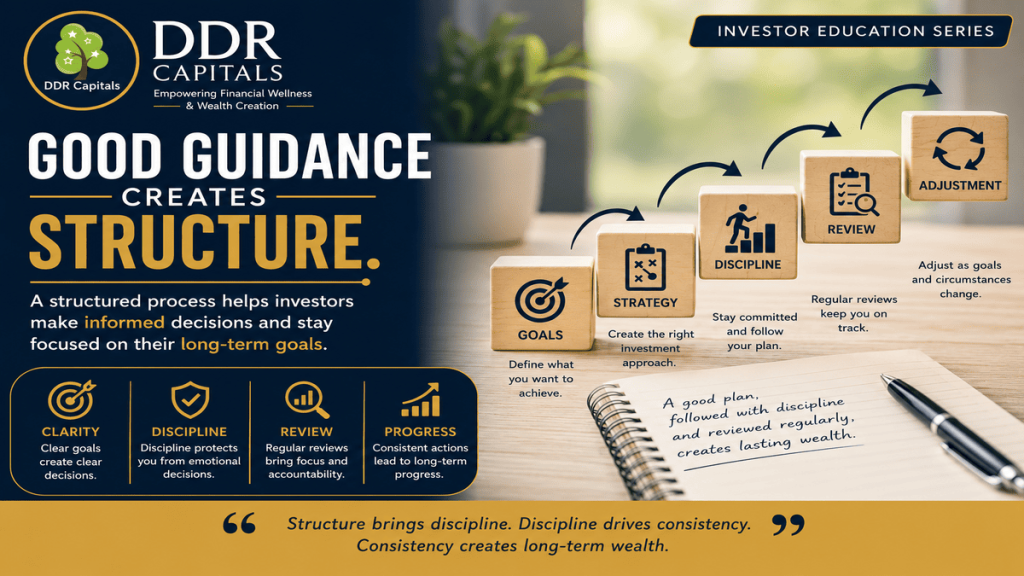
GOOD GUIDANCE CREATES STRUCTURE.
Goals → Strategy → Discipline → Review → Adjustment
A structured process can help investors avoid making every decision based on the latest headline.
Advice Can Help Prevent Costly Mistakes
Some investment mistakes cannot be measured simply by looking at the return of an individual fund.
Consider an investor who exits an investment during a market decline because of fear and waits for conditions to “become safe” before investing again.
The market may recover before the investor returns.
The problem was not necessarily the investment.
The problem was the decision-making process.
This is why the behavioural side of investing deserves as much attention as investment selection.
Professional advice cannot guarantee that an investor will make the right decision every time.
But a disciplined advisory process can help investors examine decisions before acting on emotion.
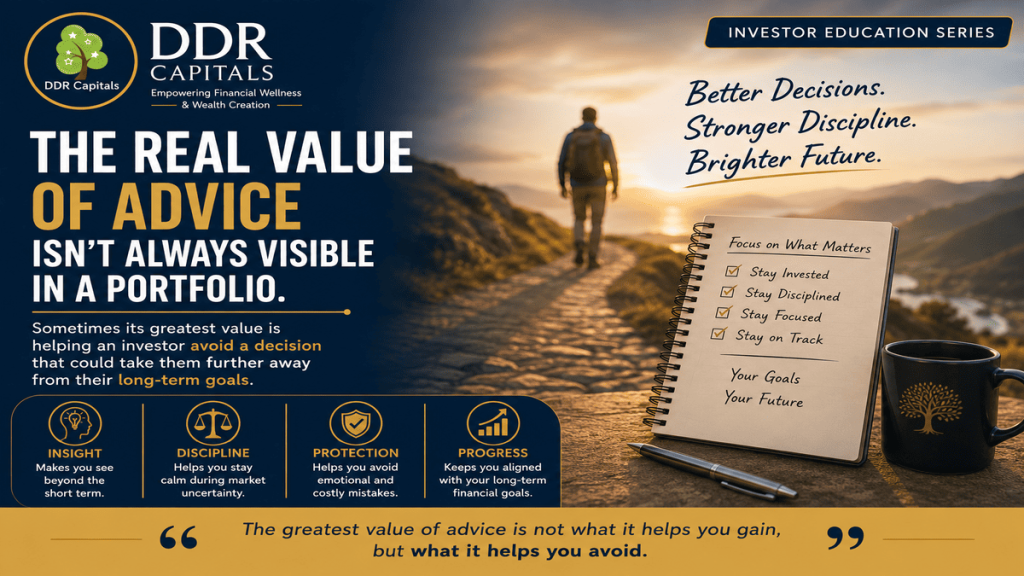
THE VALUE OF ADVICE ISN’T ALWAYS VISIBLE IN A PORTFOLIO.
Sometimes its greatest value is helping an investor avoid a decision that could take them further away from their long-term goals.
Financial Advice Is About the Journey
Wealth creation is rarely a single decision.
It is a journey involving many decisions over many years.
Income changes.
Goals change.
Families grow.
Financial responsibilities evolve.
Markets move through different cycles.
Investment portfolios may need to be reviewed and adjusted as circumstances change.
This is where ongoing financial guidance can become valuable.
The relationship is not simply about choosing an investment at the beginning.
It is about periodically asking whether the strategy still makes sense for the investor’s current circumstances and long-term objectives.
Key Takeaways
Financial advice is about more than investment selection.
Good advice connects investments with financial goals and personal circumstances.
Behavioural discipline can be as important as investment selection.
A good advisor provides perspective during uncertain markets.
Regular reviews create accountability and help identify changes in goals or circumstances.
Professional guidance cannot eliminate market risk or guarantee returns.
The real value of advice is helping investors make informed, disciplined decisions over time.
Conclusion
The hidden value of financial advice is not always visible on a portfolio statement.
It can be found in the decisions an investor makes during difficult periods.
It can be found in the discipline to stay focused on long-term goals.
It can be found in having someone who asks the right questions when emotions are high.
And it can be found in regularly reviewing whether the investment strategy still fits the investor’s changing circumstances.
A good advisor does not need to predict every market movement.
The greater value may be helping investors understand their decisions, remain disciplined and stay focused on the journey toward their financial goals.
Continue Your Investor Education Journey
Article 6: A Good Advisor Doesn’t Predict Markets
Article 7: The Hidden Behavior Gap in Wealth Creation
Article 8: Power of Compounding in Investing
Article 9: Why Market Volatility Is Not the Real Risk
Article 10: The Hidden Value of Financial Advice
Disclaimer
This article is intended solely for investor education and awareness. It should not be construed as investment advice, a recommendation, or a solicitation to buy or sell any financial product or security. Investment decisions should be made after considering individual financial circumstances, investment objectives and risk profile.
About the Author
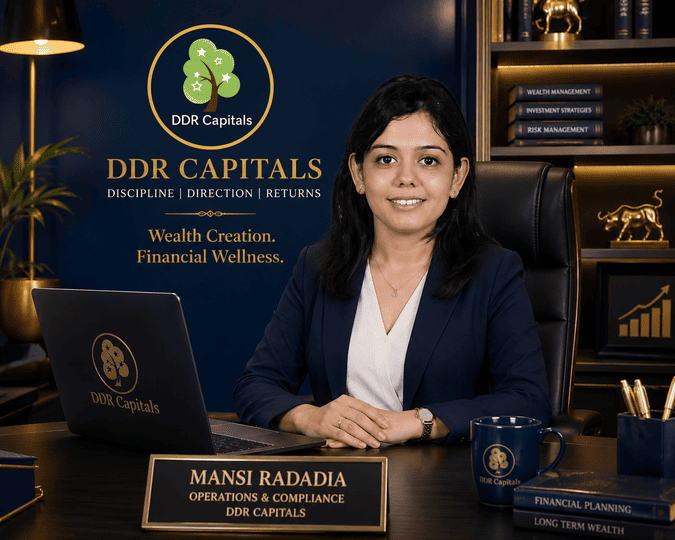
Mrs. Mansi Radadia , Operations & Compliance Officer, DDR Capitals. Contributor – Investor Education Series. With a strong focus on investor servicing, operational excellence and regulatory compliance, she is committed to helping investors navigate their financial journey with confidence. She believes successful wealth creation is built on discipline, informed decision-making and staying invested through changing market cycles. She actively supports investor education initiatives and encourages investors to explore Investor Education Resources.