
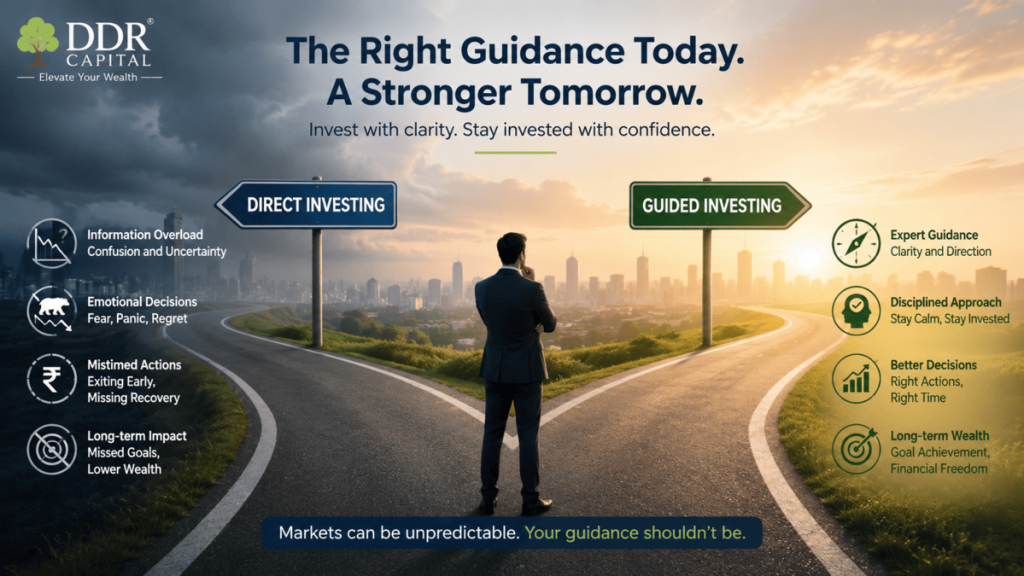
Guided investing and direct investing are often compared based on costs, returns and flexibility. Most investors spend considerable time comparing expense ratios, fund rankings and historical returns before making an investment decision. While cost matters, there is another question investors should ask themselves: What happens when markets become uncomfortable? The answer often determines long-term investment success.
The Cost Everyone Sees
Direct investing has become increasingly popular.
Investors can now access information, compare products, and invest with just a few clicks. Lower expense ratios make direct investing attractive, particularly during rising markets.
The savings are visible.
The benefits are measurable.
The decision appears straightforward.
But investing is not merely about selecting products.
It is also about managing behaviour.
See article on Every Bull Market Creates Experts. Every Bear Market Exposes Them. https://ddrcapitals.com/bull-market-investor-psychology/
The Cost Few Investors Notice
The real cost of investing without guidance is rarely visible in a fund statement.
Most investors do not lose wealth because they selected the wrong fund. They lose wealth because they make emotional decisions at the wrong time.
Markets move in cycles. Bull markets create confidence. Bear markets create fear. During periods of uncertainty, many investors stop SIPs, delay investments, switch strategies repeatedly, or exit markets altogether.
These decisions often have a far greater impact on long-term wealth creation than a difference of one or two percentage points in annual expenses.
The cost is not always paid in fees. Sometimes it is paid through missed opportunities.

Why Guidance Matters
Guidance provides more than investment recommendations.
A good advisor helps investors remain focused on their financial goals when emotions begin to influence decisions. They provide perspective during market declines, encourage discipline during uncertainty, and help investors maintain a long-term approach.
The objective is not to predict every market movement. The objective is to ensure that investors remain committed to a well-structured financial plan through different market environments.
Consistency often creates more wealth than perfect timing.
Guided Investing vs Direct Investing
Direct investing offers flexibility and lower costs, which can be beneficial for experienced investors who have the knowledge, time and emotional discipline to manage investments independently.
However, successful investing is not determined only by selecting the right products. It is equally influenced by investor behaviour during periods of market uncertainty.
Guided investing provides structure, accountability and professional perspective. A trusted advisor can help investors avoid emotional reactions, maintain asset allocation discipline and stay aligned with long-term financial objectives.
The difference may appear small during rising markets. However, during market corrections and periods of volatility, guidance often helps investors remain invested when emotions suggest otherwise.
For many investors, the value of guidance is not measured by market outperformance alone. It is measured by the ability to stay committed to a financial plan and achieve long-term wealth creation goals.
A qualified advisor not only helps investors choose investments but also helps them avoid behavioural mistakes that can significantly impact long-term wealth creation.
A Simple Question Every Investor Should Ask
Before choosing between direct and guided investing, investors should ask themselves a simple question:
“Will I remain disciplined when markets become uncomfortable?”
If the answer is uncertain, professional guidance may provide significant value beyond investment selection.
Wealth is rarely created through perfect market timing. More often, it is created through patience, consistency, discipline and staying invested through multiple market cycles.
Common Mistakes Investors Make Without Guidance
Investors often make behavioural mistakes such as panic selling during market declines, stopping SIPs during volatility, chasing recent performance and attempting to time the market. These actions can reduce long-term returns and weaken the benefits of compounding.
Final Thoughts on Guided Investing
The real cost of investing without guidance is often invisible. It appears in missed opportunities, emotional decisions, interrupted compounding and abandoned financial plans.
While direct investing may reduce expenses, guided investing can help investors avoid mistakes that may ultimately prove far more costly.
Successful investing is not only about choosing investments. It is about making better decisions consistently over time.
In many cases, Guided Investing is not an expense. It is an investment in better investor behaviour and long-term wealth creation.
Need Professional Investment Guidance?
At DDR Capitals, we help investors stay focused on their long-term financial goals through disciplined, goal-based wealth management and investment guidance.
Whether you are building wealth, planning for retirement, or seeking a structured investment approach, our team can help you make informed decisions with confidence.
Contact DDR Capitals today to discuss your financial goals and investment journey.

About the Author
Mrs. Mansi Radadia serves as Operations & Compliance Officer at DDR Capitals. With a strong focus on investor servicing, operational excellence, and regulatory compliance, she is committed to helping investors navigate their financial journey with confidence. She believes that successful wealth creation is built on discipline, informed decision-making, and staying invested through changing market cycles.
Mrs. Mansi Radadia serves as the Operations & Compliance Officer at DDR Capitals.