
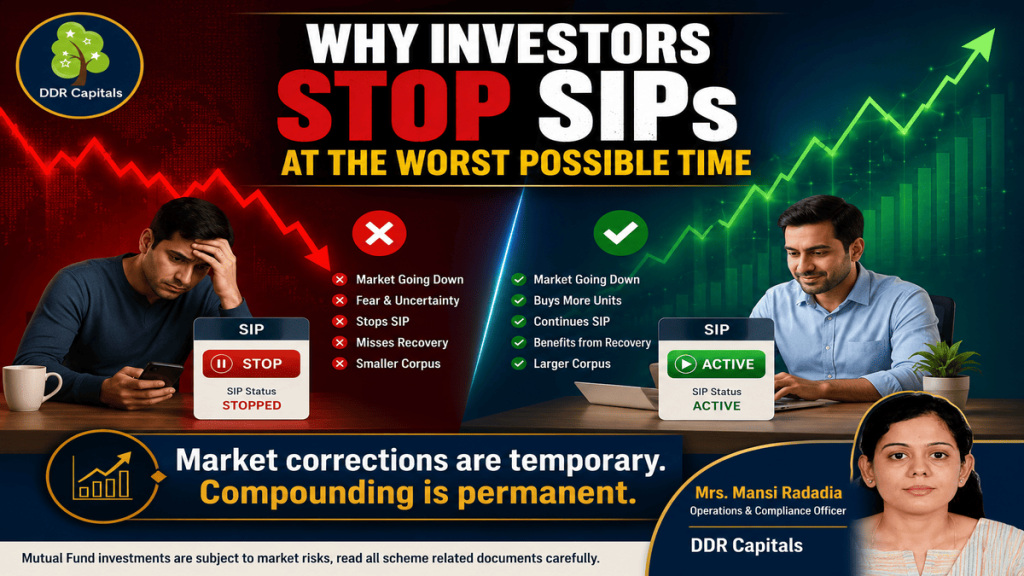
Market corrections are an inevitable part of investing. Yet every time markets decline, many investors begin questioning their SIPs. Negative returns, falling portfolio values and pessimistic headlines often create fear and uncertainty. Why investors stop SIPs during market corrections is one of the most important behavioural lessons in long-term investing.
Unfortunately, this is precisely when SIP investing becomes most powerful. Why investors stop SIPs during market corrections often determines their long-term investment outcomes.
Investors who stop SIPs during corrections often miss the opportunity to accumulate more units at lower prices and participate fully in the eventual recovery. Successful investors understand that volatility is not the enemy of wealth creation — emotional decisions are.
One of the biggest mistakes investors make is stopping SIPs during market corrections.
Stopping or modifying SIPs may be appropriate in certain personal financial situations. Investment decisions should be aligned with financial goals, risk profile and cash-flow requirements.
WHEN MARKETS FALL, MOST INVESTORS THINK: LET ME PAUSE MY SIP

During market corrections, many investors begin questioning their SIP investments. Falling portfolio values and negative headlines create fear and uncertainty. The natural reaction is to pause or stop investments until markets recover.
Unfortunately, this emotional response often works against long-term wealth creation. Market corrections provide SIP investors with an opportunity to accumulate more units at lower prices, which can significantly improve long-term outcomes.
Investors who stop SIPs during difficult periods often miss one of the biggest advantages of systematic investing — buying more when prices are lower.
Successful investors understand that temporary market declines are not a signal to stop investing; they are often an opportunity to continue investing with greater conviction.
WHY STOPPING SIPs HURTS LONG-TERM WEALTH CREATION
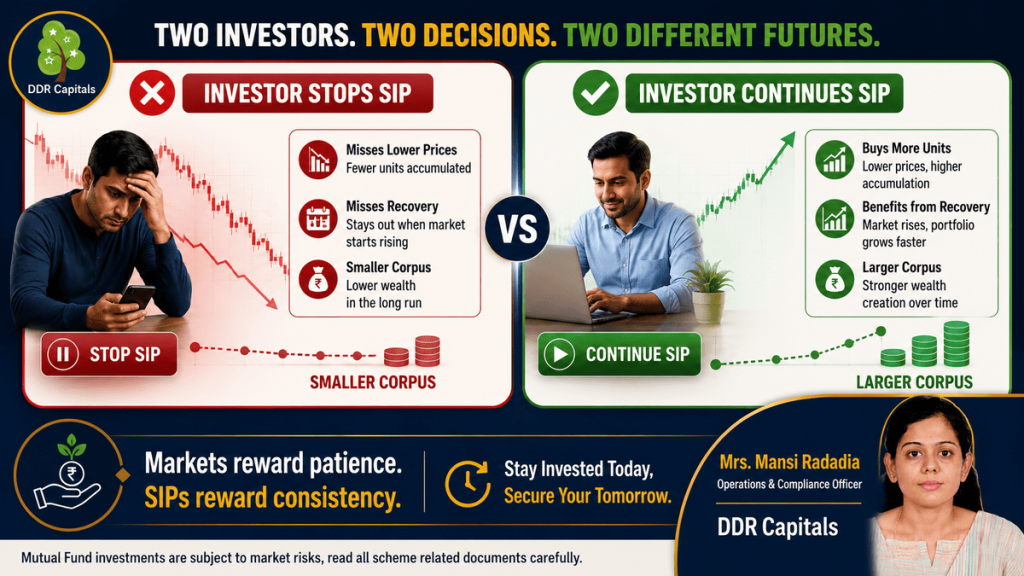
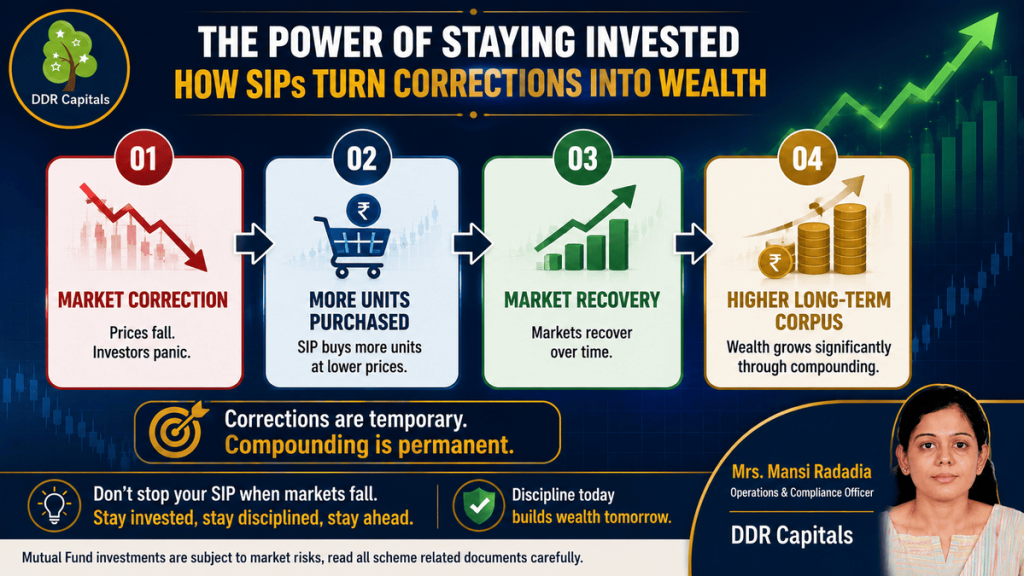
One of the biggest advantages of SIP investing is rupee cost averaging. When markets decline, the same SIP amount purchases more units at lower prices. These additional units often become the biggest contributors to wealth creation when markets recover.
Unfortunately, many investors do the exact opposite. They stop SIPs during corrections and restart them only after markets recover and prices rise again.
By stopping SIPs during falling markets, investors miss the opportunity to accumulate more units at attractive valuations and reduce the long-term benefits of compounding.
Successful investors understand a simple principle: market corrections are temporary, but the benefits of disciplined investing can last for decades.
CORRECTIONS CREATE OPPORTUNITIES, NOT PROBLEMS
Most investors view market corrections as a threat. Successful investors view them as an opportunity.
A falling market allows SIP investors to accumulate more units with the same monthly investment amount. When markets eventually recover, these additional units contribute significantly to long-term wealth creation.
This is the power of rupee cost averaging. Instead of fearing volatility, disciplined investors use it to their advantage.
History has repeatedly shown that markets recover over time. Investors who remain invested during difficult periods are often rewarded for their patience and discipline.
The objective of SIP investing is not to avoid market corrections. The objective is to use market corrections to build wealth more efficiently.
WHY INVESTORS STOP SIPs AND SUCCESSFUL INVESTORS DON’T
Market corrections reveal the difference between emotional investors and disciplined investors.
Emotional investors ask:
• Should I stop my SIP?
• Should I wait for markets to recover?
• Should I invest again when things look better?
Disciplined investors ask:
• Can I continue my SIP?
• Can I increase my investment during corrections?
• Can I stay focused on my long-term goals?
The difference in these questions often determines the difference in long-term outcomes.
The best time to continue a SIP is often when emotions suggest doing the opposite. Investors who remain disciplined during periods of uncertainty are frequently rewarded when markets recover and compounding begins to accelerate wealth creation.

CALL TO ACTION
Have you ever considered stopping your SIP during a market correction?
Did you continue investing or pause your contributions?
What was the outcome of that decision?
Share your experience in the comments or connect with DDR Capitals to discuss your long-term investment journey.
About Author

Mrs. Mansi Radadia serves as Operations & Compliance Officer at DDR Capitals. With a strong focus on investor servicing, operational excellence and regulatory compliance, she is committed to helping investors navigate their financial journey with confidence. She believes successful wealth creation is built on discipline, informed decision-making and staying invested through changing market cycles.